

Milestones
- DOE cost-share award with Southern CompanyDec 2020Complete.
- Integrated Effects Test loop operating2023Complete.
- MCRE test reactor starts its chain reaction at INLNot yet reached.
Most important updates
- INL delivers the first enriched uranium chloride fuel-salt batch for MCRE, the first such fuel made for a fast reactorSep 2025
- Idaho National Laboratory reports a fuel-salt production milestone for the Molten Chloride Reactor ExperimentMar 2025
- Southern Company and TerraPower finish the Integrated Effects Test, the nuclear sector's largest chloride-salt loopOct 2022
- TerraPower and Southern Company finalise their agreement to build and run the Molten Chloride Reactor Experiment at INLFeb 2022
Upcoming
- 2028Molten Chloride Reactor Experiment expected to run at INL for about six months (next)
Current obstacles
- Salt eats metalHot chloride salt full of fission products corrodes metal; proving materials that last decades is unsolved.
Physics limits
- Chlorine-35 turns into long-lived wasteNatural chlorine is 76% chlorine-35, which captures neutrons and becomes chlorine-36 (301,000-year half-life). Avoiding it means costly enrichment to chlorine-37.
- Fission products circulate with the fuelWith fuel dissolved, radioactive fission products flow through pumps and heat exchangers instead of staying sealed in solid pellets, so the whole loop turns intensely radioactive.
- Flowing fuel shrinks the control marginReactors are controllable because ~0.65% of neutrons arrive seconds late. In flowing fuel, some atoms that emit them decay outside the core, shrinking that margin.
How it works
Fuel dissolved in the coolant
Uranium is dissolved as a chloride in molten salt, so the liquid is both fuel and coolant; it flows through the core and out to heat exchangers.
No moderator needed
Chlorine slows neutrons far less than water or graphite, so fission runs on fast neutrons, which lets the reactor burn more of its uranium.
Low pressure, self-limiting
The salt boils only well above 1,000 °C, so the loop runs near atmospheric pressure; if it heats up, the salt expands and fission slows.
MCRE checks the physics
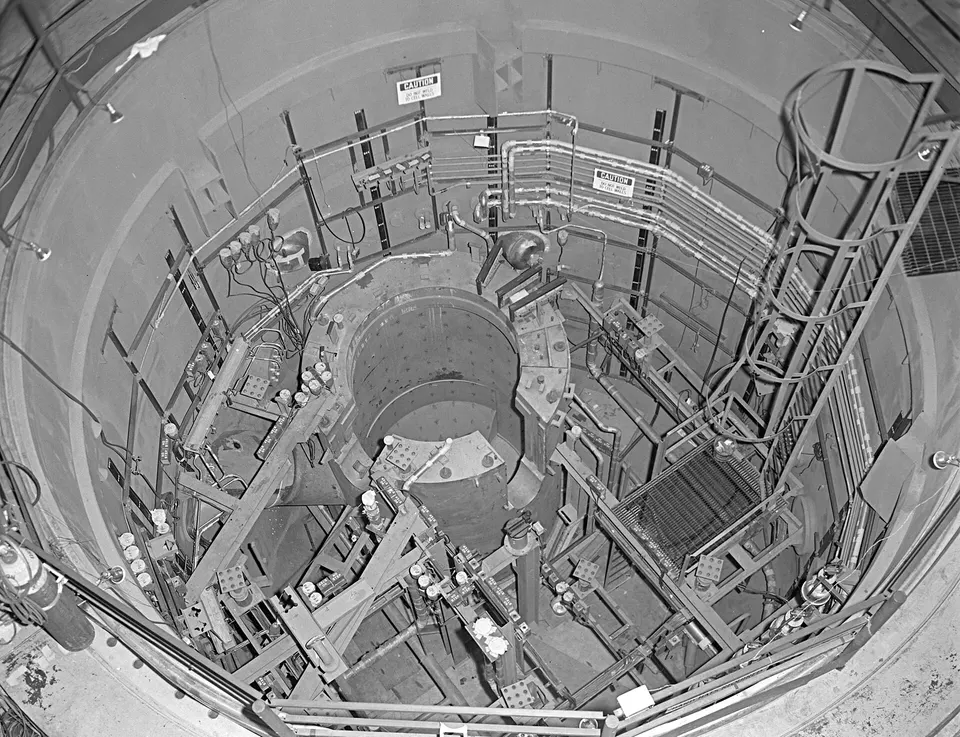
The Molten Chloride Reactor Experiment at INL is a small critical test, planned to run about six months, to measure how a fast salt core behaves.
Update log
Sep 2025
Mar 2025
Oct 2022
Feb 2022
About TerraPower
TerraPower
Natrium sodium fast reactor, molten salt storage
Nuclear company founded by Bill Gates. Its Natrium plant in Kemmerer, Wyoming pairs a 345 MWe sodium-cooled reactor with molten-salt heat storage that can boost output to 500 MWe. In March 2026 it won the first NRC construction permit for a commercial reactor not cooled by ordinary water.
- Won its NRC construction permit in March 2026 and started nuclear construction in April 2026.
- Molten-salt tanks sit between reactor and turbine, so a 345 MWe reactor can peak at 500 MWe.
- Operation targeted for 2030, slipped from 2028 mainly by a shortage of HALEU fuel.
- Founded
- 200818 yrs
- Headquarters
- United States
- Status
- Private
- Valuation
- private
- Raised
- $1.4B2 rounds
- Last round
- Equity raise · $650MJun 2025
- Works in
- EnergyFission
- Coverage
- 2 programs · 14 updateslatest 19d agochecked 25 Sep
- Lead investors
- SK Inc.Bill Gates
- Customers
- Meta
- Partners
- U.S. Department of Energy (opens energy.gov)PacifiCorp (opens pacificorp.com)GE Vernova Hitachi Nuclear Energy (opens gevernova.com)
- Investors
- SK Inc. (opens sk-inc.com)NVIDIA
- People
- Chris Levesque (opens terrapower.com)President & CEOBill Gates (opens en.wikipedia.org)Founder & Chairman