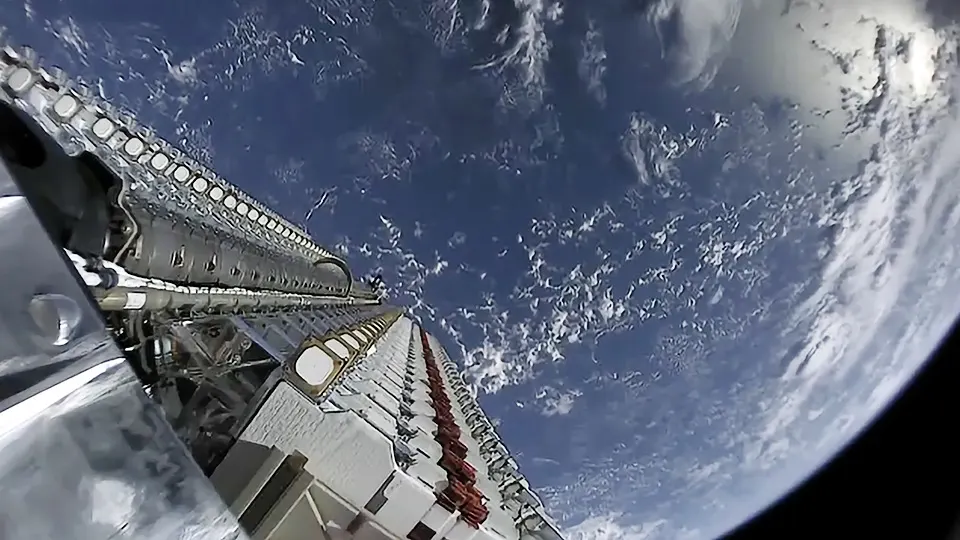

Milestones
- First 60 production-prototype satellites launched23 May 2019Complete.
- First direct-to-cell satellites launchedJan 2024Complete.
- 10.3 million subscribers (end of Q1 2026)31 Mar 2026Complete.
- First Starlink V3 satellites deployed to orbit by StarshipNowCurrent milestone.
Most important updates
- Sep 2025
- 24 Jul 2025
- 23 Jul 2025
- 19 Dec 2022
Current obstacles
- Space junk and bright skiesThousands of satellites raise collision risk and streak telescope images; lower orbits and dark coatings help but don't fix it.
Physics limits
- Radio spectrum caps capacity per areaEach beam covers a cell tens of km wide, and all users in it share a fixed slice of spectrum. Shannon's law caps the bits per hertz, so dense towns hit a ceiling that more satellites overhead only partly lift.
- Low orbits decay, so satellites are short-livedAt about 550 km the thin air still drags on satellites. They need thrusters to stay up and fall back within about five years once dead, so the fleet must be replaced continuously.
- Crowded orbits raise the collision riskThousands of satellites at similar heights must dodge each other and debris. A single collision at 10 km/s makes thousands of fragments, and the risk grows faster than the number of objects.
How it works
Low and many
Satellites fly about 550 km up, 65 times closer than TV satellites, so signals take milliseconds. Each sees a small patch, so thousands are needed.
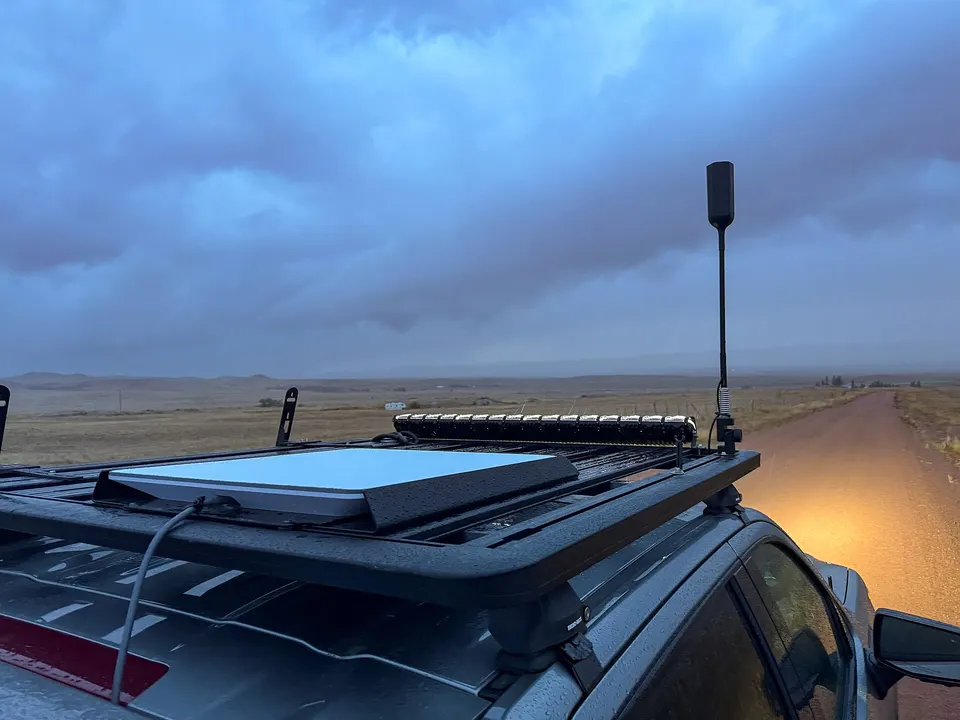
A flat antenna that steers by electronics
The user dish is a phased array: hundreds of tiny antennas timed to aim a beam at a satellite and hand over to the next one, with no moving parts.
Data hops between satellites
Laser links pass traffic from satellite to satellite, so ships, planes and remote areas can be served far from any ground station.
Cell towers in orbit
Direct-to-cell satellites carry large antennas that speak ordinary mobile frequencies, so unmodified phones can text and use data in dead zones.
Update log
Sep 2025
- Major: PressCommercial
Thu 24 Jul 2025
- Minor: PressSoftware
Wed 23 Jul 2025
- Major: PressCommercial
Mon 19 Dec 2022
- Minor: PressCommercial
About SpaceX
SpaceX
Starship, Falcon 9, Dragon, Starlink, xAI
SpaceX builds the reusable Falcon 9 rocket, the Dragon capsule, the Starlink internet satellites and the giant Starship. It flies most of the world's launches, merged with Elon Musk's xAI in Feb 2026 and listed on Nasdaq in June 2026.
- Falcon 9 flew about 165 missions in 2025, most of them Starlink, on boosters now reflown 30+ times.
- Starship V3 (Raptor 3, Pad 2) debuted in May 2026; Flight 14 in late September 2026 is planned as the first orbital Starship flight.
- Starlink passed 12 million subscribers by mid-2026 and funds Starship; the June 2026 IPO raised about $86B.
- Founded
- 200224 yrs
- Headquarters
- United States
- Status
- Public
- Listed
- SPCX (opens google.com)NASDAQ
- Valuation
- $2Tmarket capSep 2026
- Raised
- $1B1 round
- Last round
- IPO (Nasdaq) · $86B12 Jun 2026
- Works in
- SpaceflightLaunchAIComputing
- Coverage
- 5 programs · 28 updateslatest 2d agochecked 25 Sep
- Lead investors
- Goldman SachsMorgan StanleyGoogleFidelity
- Partners
- xAIT-Mobile (opens t-mobile.com)
- Suppliers
- EchoStar (opens echostar.com)
- People
- Elon Musk (opens en.wikipedia.org)Founder, CEO and CTOGwynne Shotwell (opens en.wikipedia.org)President and COO