
Milestones
- First Falcon 9 launch4 Jun 2010Complete.
- First orbital-class booster landing (ORBCOMM-2)21 Dec 2015Complete.
- First reflight of a landed booster (SES-10)30 Mar 2017Complete.
- Falcon Heavy debut6 Feb 2018Complete.
- Record year: ~165 Falcon 9 launches2025Complete.
Most important updates
- 30 Mar 2026
- 28 Aug 2025
- 11 Jul 2024
- 1 Sep 2016
- 28 Jun 2015
Current obstacles
- Upper stage is expendableEvery flight still throws away the upper stage and its engine, which limits how cheap Falcon can get. That's why Starship exists.
Physics limits
- The rocket equation makes payload a sliver of launch massOrbit needs about 9.4 km/s of speed change including losses. Fuel needed grows exponentially with that, so even the best rockets put only 2 to 5% of their liftoff mass into low orbit.
- Every kilogram used to come home is a kilogram not carriedA returning booster keeps fuel for boostback and landing, plus legs or fins; this costs roughly 25 to 40% of payload versus throwing it away. Upper stages pay even more, since they are going at orbital speed.
- Kerosene engines leave soot behindBurning kerosene deposits carbon in the engine's pumps and cooling passages. That makes cleaning and inspection part of every turnaround, one reason newer reusable engines switch to methane.
How it works
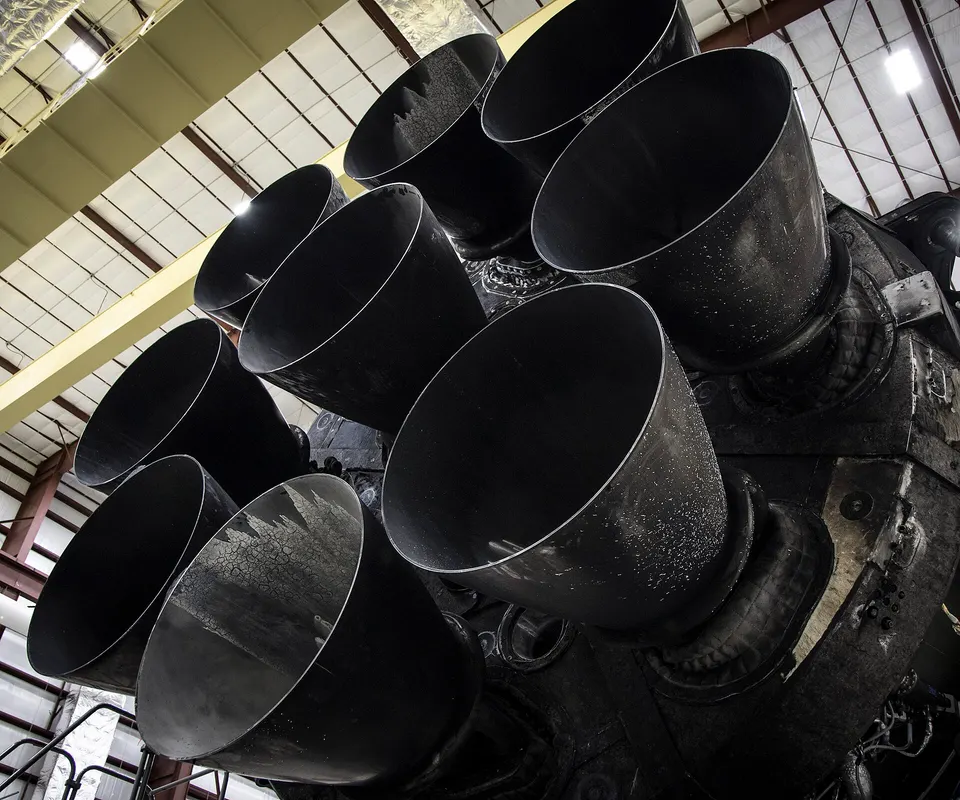
Nine kerosene engines
Nine Merlin engines burn kerosene and liquid oxygen for about 2.5 minutes, then the first stage separates at roughly 8,000 km/h.
Flips, brakes and lands
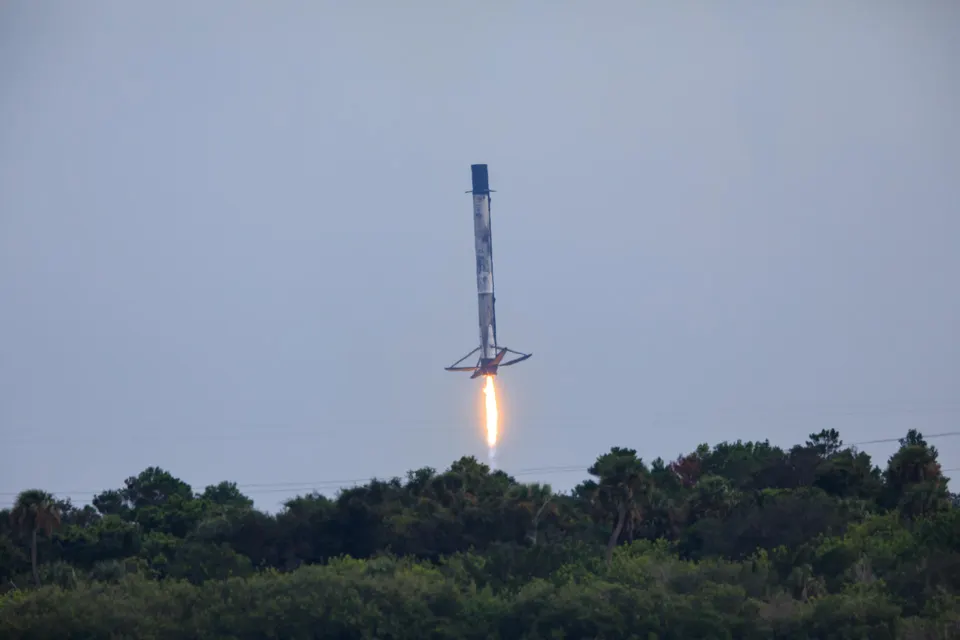
The booster flips, relights to slow down, steers with grid fins through the air and lands on legs, on a drone ship or back near the pad.
A single-engine upper stage
One vacuum Merlin pushes the payload the rest of the way to orbit. This stage is thrown away; it is the main cost still left per flight.
Refurbish and refly
Boosters are inspected and reflown in weeks; the fairing halves fall under parachutes and are fished out of the sea and reused.
Update log
Mon 30 Mar
- Minor: PressTest
Thu 28 Aug 2025
- Minor: PressTest
Thu 11 Jul 2024
- Major: PressTest
Thu 1 Sep 2016
- Major: PressTest
Sun 28 Jun 2015
- Major: PressTest
About SpaceX
SpaceX
Starship, Falcon 9, Dragon, Starlink, xAI
SpaceX builds the reusable Falcon 9 rocket, the Dragon capsule, the Starlink internet satellites and the giant Starship. It flies most of the world's launches, merged with Elon Musk's xAI in Feb 2026 and listed on Nasdaq in June 2026.
- Falcon 9 flew about 165 missions in 2025, most of them Starlink, on boosters now reflown 30+ times.
- Starship V3 (Raptor 3, Pad 2) debuted in May 2026; Flight 14 in late September 2026 is planned as the first orbital Starship flight.
- Starlink passed 12 million subscribers by mid-2026 and funds Starship; the June 2026 IPO raised about $86B.
- Founded
- 200224 yrs
- Headquarters
- United States
- Status
- Public
- Listed
- SPCX (opens google.com)NASDAQ
- Valuation
- $2Tmarket capSep 2026
- Raised
- $1B1 round
- Last round
- IPO (Nasdaq) · $86B12 Jun 2026
- Works in
- SpaceflightLaunchAIComputing
- Coverage
- 5 programs · 27 updateslatest 29 Aug 2026checked 25 Sep
- Lead investors
- Goldman SachsMorgan StanleyGoogleFidelity
- Partners
- xAIT-Mobile (opens t-mobile.com)
- Suppliers
- EchoStar (opens echostar.com)
- People
- Elon Musk (opens en.wikipedia.org)Founder, CEO and CTOGwynne Shotwell (opens en.wikipedia.org)President and COO