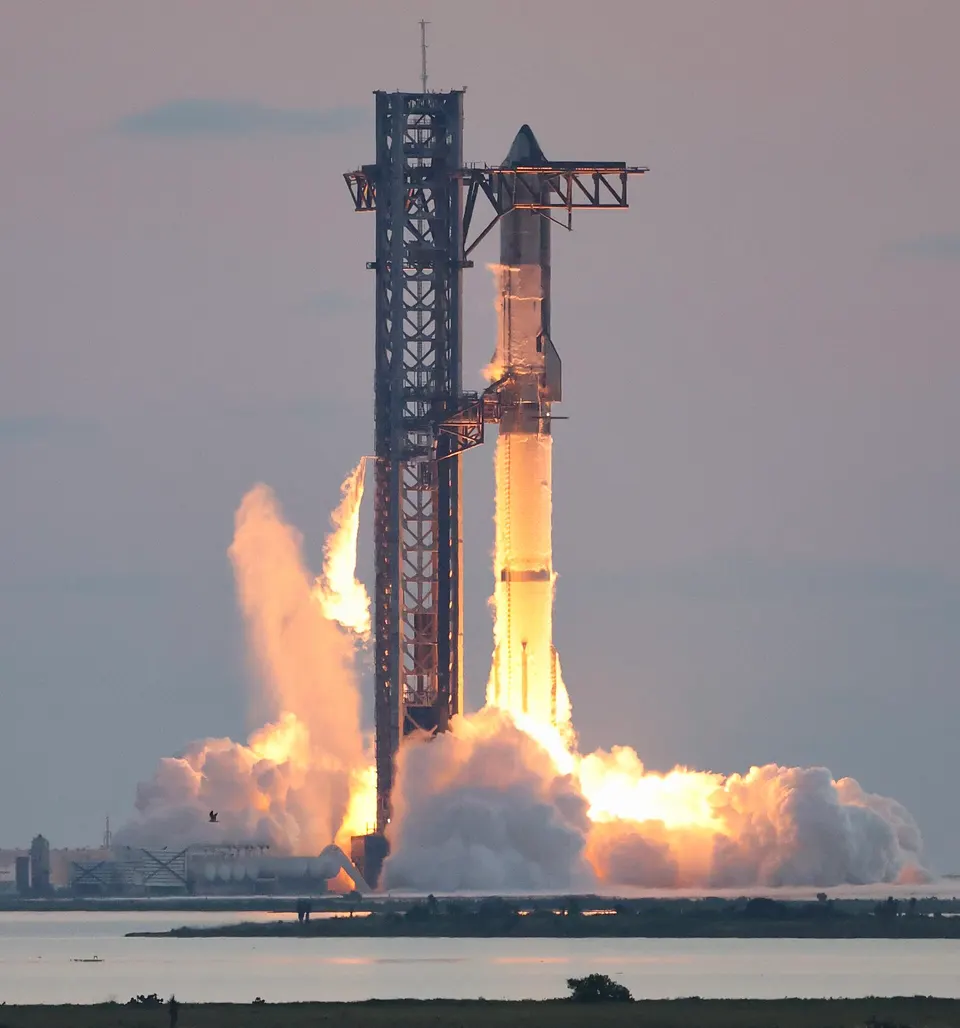

Milestones
- Flight 1: first integrated launch (B7/S24)20 Apr 2023Complete.
- Flight 2: first hot staging (B9/S25)18 Nov 2023Complete.
- Flight 3: reached space, moved fuel inside the ship (B10/S28)14 Mar 2024Complete.
- Flight 4: first soft splashdowns of both stages (B11/S29)6 Jun 2024Complete.
- Flight 5: first booster catch by tower arms (B12/S30)13 Oct 2024Complete.
- Flight 10: first fully successful V2 flight (B16/S37)26 Aug 2025Complete.
- Flight 11: final V2 flight (B15-2/S38)13 Oct 2025Complete.
- Flight 12: first V3 / Raptor 3 flight, first from Pad 2 (B19/S39)22 May 2026Complete.
- Flight 13: second V3 flight (B20/S40)24 Jul 2026Complete.
- Flight 14: first orbital Starship flight (B21/S41)Target Sep 2026Current milestone.
- First catch of a Starship upper stage by the towerNot yet reached.
- Ship-to-ship refuelling test in orbitNot yet reached.
Most important updates
- 24 Jul 2026
- 22 May 2026
- 21 Nov 2025
- 26 Aug 2025
- 13 Oct 2024
Upcoming
- Sep 2026Flight 14: first orbital Starship flight (B21/S41) (next)
- 2027Artemis III: Orion rendezvous and docking test with commercial lander(s) in Earth orbit
Current obstacles
- A heat shield that needs no refurbishmentTiles have cracked and fallen off, letting hot plasma reach the steel. The shield must last many flights with little repair.
- Engines that work every time2025 ship losses came from leaks and fires near the engines. With 39 engines, every relight must work to land and to be safe for crew.
- Refuelling in orbitMoving super-cold fuel between two ships in zero gravity, and keeping it from boiling off for weeks, has never been done at this scale.
Physics limits
- The rocket equation makes payload a sliver of launch massOrbit needs about 9.4 km/s of speed change including losses. Fuel needed grows exponentially with that, so even the best rockets put only 2 to 5% of their liftoff mass into low orbit.
- Coming back from orbit means shedding enormous heatAt 7.8 km/s every kilogram carries about 30 MJ, the energy of 7 kg of TNT. Air turns it into heat at over 1,500 °C on the shield, so every returning vehicle carries heavy protection that wears.
- Refuelling in orbit fights boil-off and weightless fuelLiquid oxygen boils at −183 °C and methane at −162 °C, so sunlight steadily boils them away. In weightlessness fuel floats, so it must be settled with small thrusts before it can be pumped between ships.
How it works
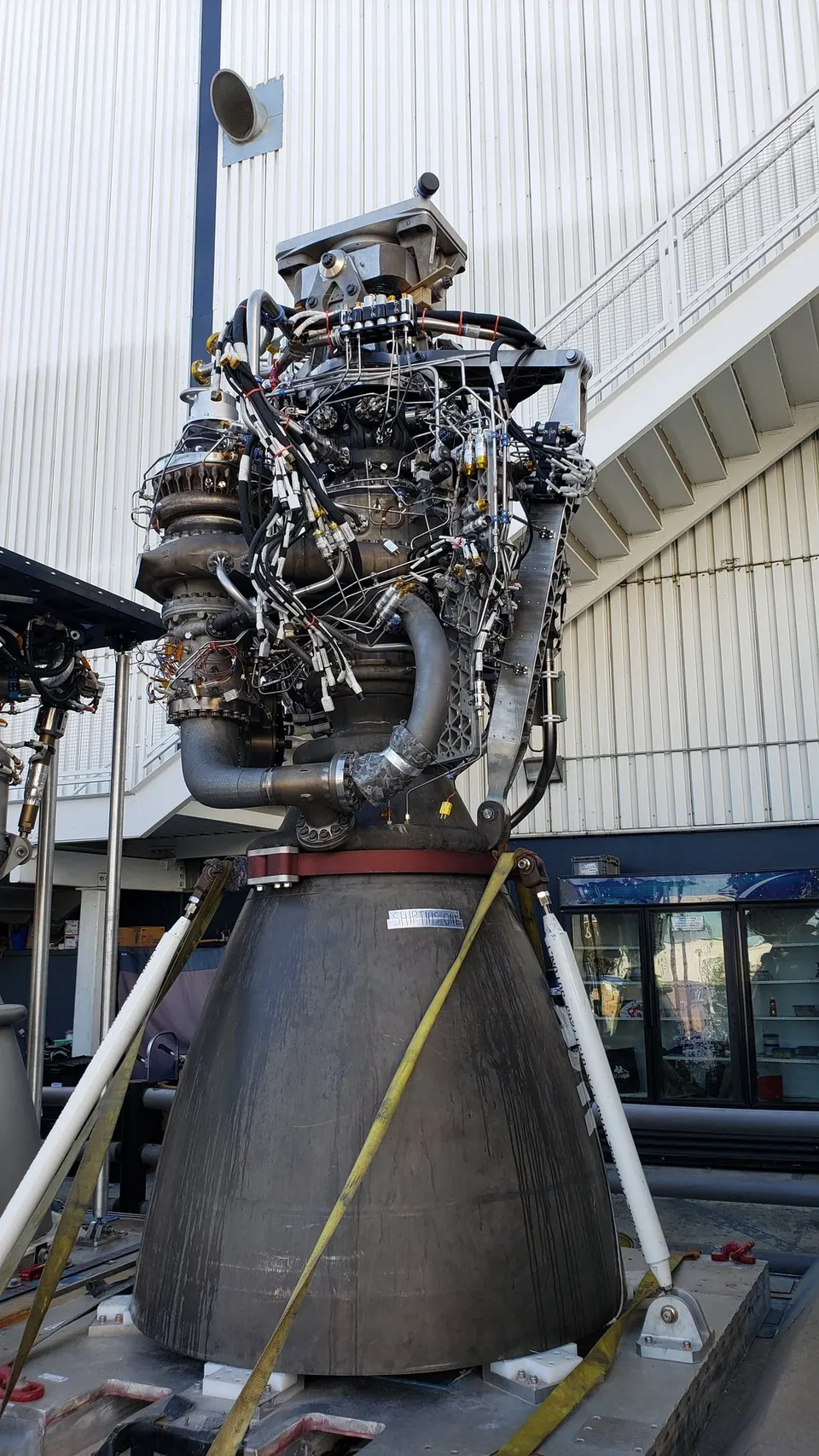
Super Heavy and the tower catch
33 Raptor engines lift the stack. The booster flies back, relights and is caught by the tower's arms; skipping landing legs saves weight and speeds reuse.
Hot staging
The ship lights its engines while still attached, venting exhaust through a ring. Separating without a coast phase avoids losing speed to gravity.
Coming back on a tiled belly
The steel ship falls belly-first behind thousands of heat tiles, steering with four flaps like a skydiver, then flips upright and fires engines to land.
Tankers refill it in orbit
For the Moon or Mars, tanker Starships launch one after another to fill a depot ship, which then refuels the mission ship.
Spec sheet
| Spec | Starship | Starship V2 (Block 2) | Change |
|---|---|---|---|
| Stack height (V3) | 124.4 mR (reported) | ~123 m (V2) | ▲ 1.4 m |
| Diameter | 9 mR (reported) | — | —no comparable change |
| Super Heavy engines | 33 RaptorR (reported) | — | —no comparable change |
| Ship engines | 6 Raptor (3 sea-level, 3 vacuum)R (reported) | — | —no comparable change |
| Raptor 3 thrust (sea level) | ~280 tfR (reported) | ~230 tf (Raptor 2) | ▲ 50 tf |
| Liftoff thrust (V3) | ~9,000–10,000 tfE (estimated) | ~7,590 tf (V2) | ▲ 1,910 tf |
| Payload to LEO (reusable) | 100+ tR (reported) | — | —no comparable change |
| Propellant | Liquid methane / liquid oxygenR (reported) | — | —no comparable change |
| Ship heat shield | ~18,000 hexagonal ceramic tilesE (estimated) | — | —no comparable change |
R reported by the company · E our estimate
Peer comparison
| Spec | Starship | Blue Origin New Glenn |
|---|---|---|
| Diameter | 9 mR (reported) | 7 mR (reported) |
| Payload to LEO (reusable) | 100+ tR (reported) | 45 tR (reported) |
R reported by the company · E our estimate
Papers & demos
- 13 Oct 2024demoFirst Super Heavy booster catch by the launch tower (Flight 5) (opens spacex.com)Showed a 70 m booster can be caught by tower arms, so it needs no legs and can fly again fast.
- 14 Mar 2024demoIn-ship cryogenic propellant transfer on Starship Flight 3 (opens spacex.com)Moved liquid oxygen between tanks inside the ship in flight, a step in NASA's lander refuelling tests.
- 29 Sep 2017talkMaking Life Multiplanetary (IAC 2017, Adelaide) (opens doi.org)Resized the plan to a 9 m rocket meant to replace Falcon and Dragon; the basis of today's Starship.
Update log
Fri 24 Jul
- Major: LivestreamTest
Fri 22 May
- Major: LivestreamTest
Fri 21 Nov 2025
- Minor: PressTest
Mon 13 Oct 2025
- Minor: LivestreamTest
Tue 26 Aug 2025
- Major: LivestreamTest
Wed 18 Jun 2025
- Minor: PressTest
Sun 13 Oct 2024
- Major: LivestreamTest
About SpaceX
SpaceX
Starship, Falcon 9, Dragon, Starlink, xAI
SpaceX builds the reusable Falcon 9 rocket, the Dragon capsule, the Starlink internet satellites and the giant Starship. It flies most of the world's launches, merged with Elon Musk's xAI in Feb 2026 and listed on Nasdaq in June 2026.
- Falcon 9 flew about 165 missions in 2025, most of them Starlink, on boosters now reflown 30+ times.
- Starship V3 (Raptor 3, Pad 2) debuted in May 2026; Flight 14 in late September 2026 is planned as the first orbital Starship flight.
- Starlink passed 12 million subscribers by mid-2026 and funds Starship; the June 2026 IPO raised about $86B.
- Founded
- 200224 yrs
- Headquarters
- United States
- Status
- Public
- Listed
- SPCX (opens google.com)NASDAQ
- Valuation
- $2Tmarket capSep 2026
- Raised
- $1B1 round
- Last round
- IPO (Nasdaq) · $86B12 Jun 2026
- Works in
- SpaceflightLaunchAIComputing
- Coverage
- 5 programs · 27 updateslatest 29 Aug 2026checked 25 Sep
- Lead investors
- Goldman SachsMorgan StanleyGoogleFidelity
- Partners
- xAIT-Mobile (opens t-mobile.com)
- Suppliers
- EchoStar (opens echostar.com)
- People
- Elon Musk (opens en.wikipedia.org)Founder, CEO and CTOGwynne Shotwell (opens en.wikipedia.org)President and COO