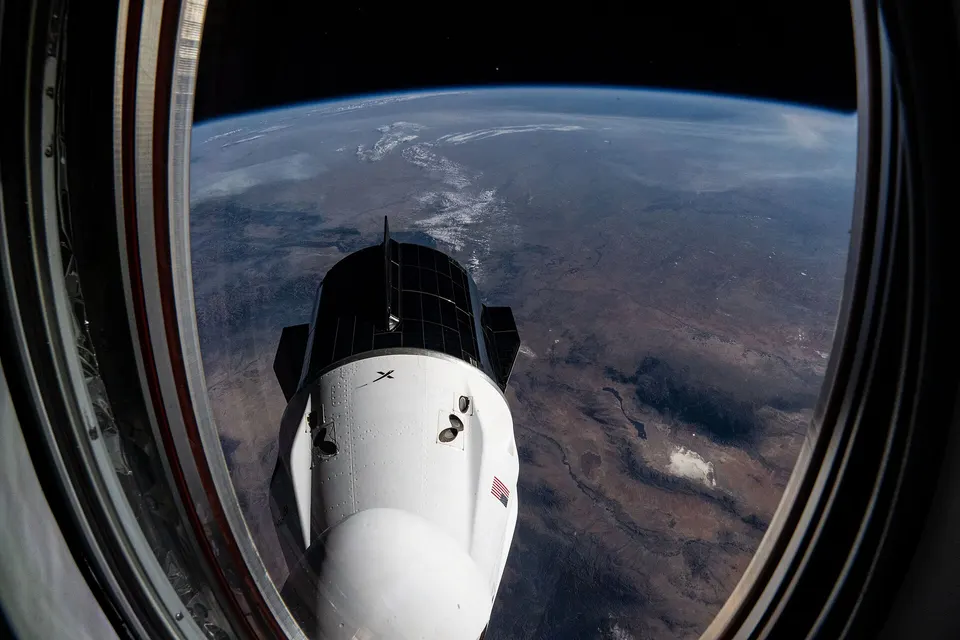

Milestones
- First commercial spacecraft to berth with ISS (cargo)25 May 2012Complete.
- Demo-2: first crewed flight30 May 2020Complete.
- Inspiration4: first all-private orbital crew16 Sep 2021Complete.
- Polaris Dawn: first commercial spacewalk12 Sep 2024Complete.
Most important updates
- 29 Aug 2026
- 15 Jan 2026
- 31 Mar 2025
- 18 Mar 2025
Upcoming
- 1 Oct 2026Crew-13 launch to the ISS on Falcon 9 (next)
- Jan 2027Ax-5 private astronaut mission to the ISS (no earlier than)
Physics limits
- Coming back from orbit means shedding enormous heatAt 7.8 km/s every kilogram carries about 30 MJ, the energy of 7 kg of TNT. Air turns it into heat at over 1,500 °C on the shield, so every returning vehicle carries heavy protection that wears.
- Capsules land hard and must splash down preciselyParachutes can only slow a capsule to about 25 km/h. Water cushions the impact, but recovery ships must be near, and wind and waves limit when a crew can come home.
- Space radiation limits how long crews can stayIn low orbit astronauts absorb roughly 0.5 mSv a day, dozens of times the dose on the ground. Career limits cap total time in space, whatever the capsule can do.
How it works
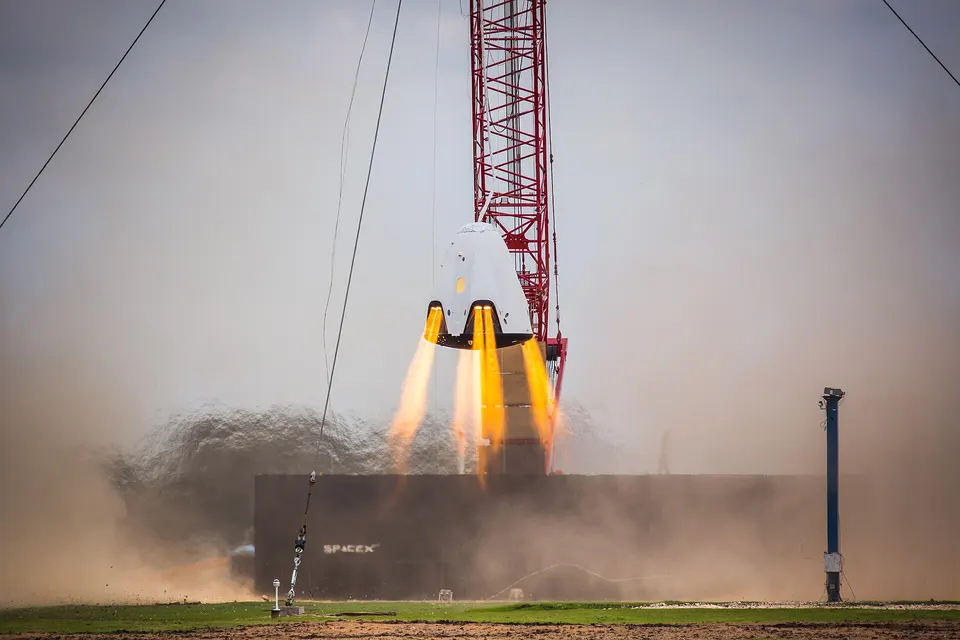
Escape
Engines built into the walls
Eight SuperDraco engines in the capsule's sides can fire within a fraction of a second to pull the crew away from a failing rocket; no escape tower.
Docking
Flies itself to the station
Cameras and lidar guide Dragon to the ISS automatically; 16 small Draco thrusters make fine moves until the docking ring latches.
Return
Heat shield and parachutes
An ablative heat shield (PICA-X) burns slowly away during reentry, then two drogue and four main parachutes lower it into the sea.
Update log
Sat 29 Aug
- Minor: RegulatorHardware
Thu 15 Jan
- Major: PressOther
Mon 31 Mar 2025
- Minor: PressCommercial
Tue 18 Mar 2025
- Major: RegulatorTest
About SpaceX
SpaceX
Starship, Falcon 9, Dragon, Starlink, xAI
SpaceX builds the reusable Falcon 9 rocket, the Dragon capsule, the Starlink internet satellites and the giant Starship. It flies most of the world's launches, merged with Elon Musk's xAI in Feb 2026 and listed on Nasdaq in June 2026.
- Falcon 9 flew about 165 missions in 2025, most of them Starlink, on boosters now reflown 30+ times.
- Starship V3 (Raptor 3, Pad 2) debuted in May 2026; Flight 14 in late September 2026 is planned as the first orbital Starship flight.
- Starlink passed 12 million subscribers by mid-2026 and funds Starship; the June 2026 IPO raised about $86B.
- Founded
- 200224 yrs
- Headquarters
- United States
- Status
- Public
- Listed
- SPCX (opens google.com)NASDAQ
- Valuation
- $2Tmarket capSep 2026
- Raised
- $1B1 round
- Last round
- IPO (Nasdaq) · $86B12 Jun 2026
- Works in
- SpaceflightLaunchAIComputing
- Coverage
- 5 programs · 27 updateslatest 29 Aug 2026checked 25 Sep
- Lead investors
- Goldman SachsMorgan StanleyGoogleFidelity
- Partners
- xAIT-Mobile (opens t-mobile.com)
- Suppliers
- EchoStar (opens echostar.com)
- People
- Elon Musk (opens en.wikipedia.org)Founder, CEO and CTOGwynne Shotwell (opens en.wikipedia.org)President and COO