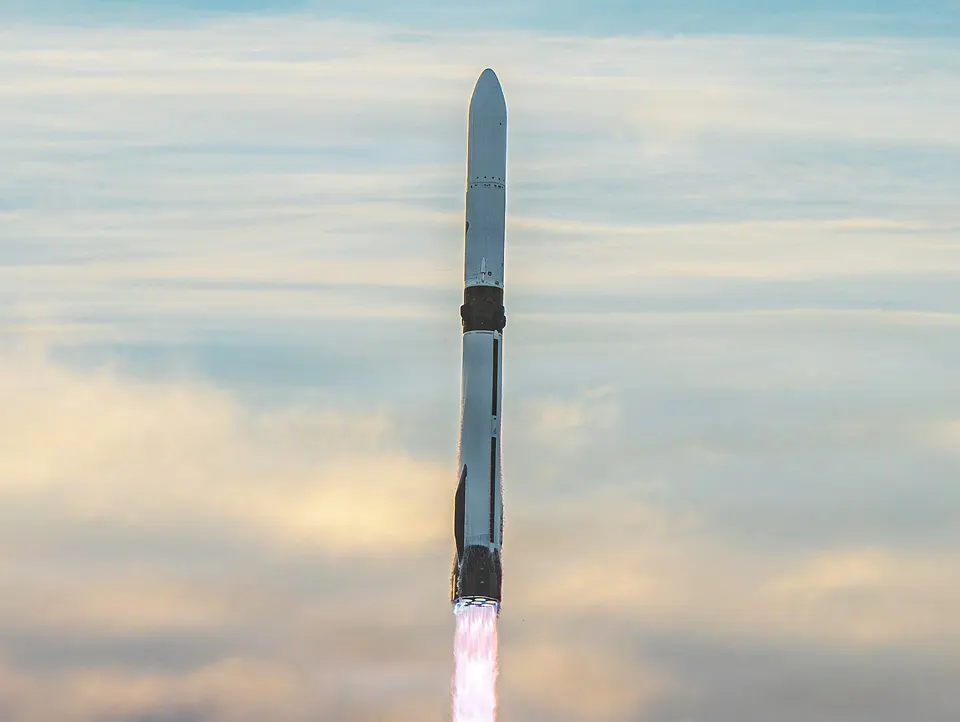

Milestones
- NG-1 maiden flight reaches orbit; booster lost16 Jan 2025+60 mo
originally 2020Complete. - NG-2 launches NASA ESCAPADE; first booster landing13 Nov 2025Complete.
- NG-3: first booster reflight; upper stage strands BlueBird 719 Apr 2026Complete.
- Rocket explodes during a test firing at LC-3628 May 2026Complete.
- Rebuild LC-36 and return to flightNowCurrent milestone.
- Launch Blue Moon MK1 pathfinder to the MoonTarget Q1 2027Not yet reached.
Most important updates
- 6 Aug 2026
- 28 May 2026
- 19 Apr 2026
- 13 Nov 2025
- 16 Jan 2025
Upcoming
- Q4 2026New Glenn return to flight targeted before end of 2026 (next)
- Q1 2027Launch Blue Moon MK1 pathfinder to the Moon
Current obstacles
- Single launch padLC-36 is New Glenn's only pad; the May 2026 explosion stops all flights until it is rebuilt.
- Upper-stage reliabilityNG-3's upper stage left a customer satellite too low to use, so it must prove itself again.
Physics limits
- The rocket equation makes payload a sliver of launch massOrbit needs about 9.4 km/s of speed change including losses. Fuel needed grows exponentially with that, so even the best rockets put only 2 to 5% of their liftoff mass into low orbit.
- Every kilogram used to come home is a kilogram not carriedA returning booster keeps fuel for boostback and landing, plus legs or fins; this costs roughly 25 to 40% of payload versus throwing it away. Upper stages pay even more, since they are going at orbital speed.
- Hydrogen upper stages trade density for efficiencyHydrogen gives the highest exhaust speed of any practical fuel, but it is 14 times less dense than water and boils at −253 °C. Tanks must be huge and well insulated, adding mass and cost.
How it works
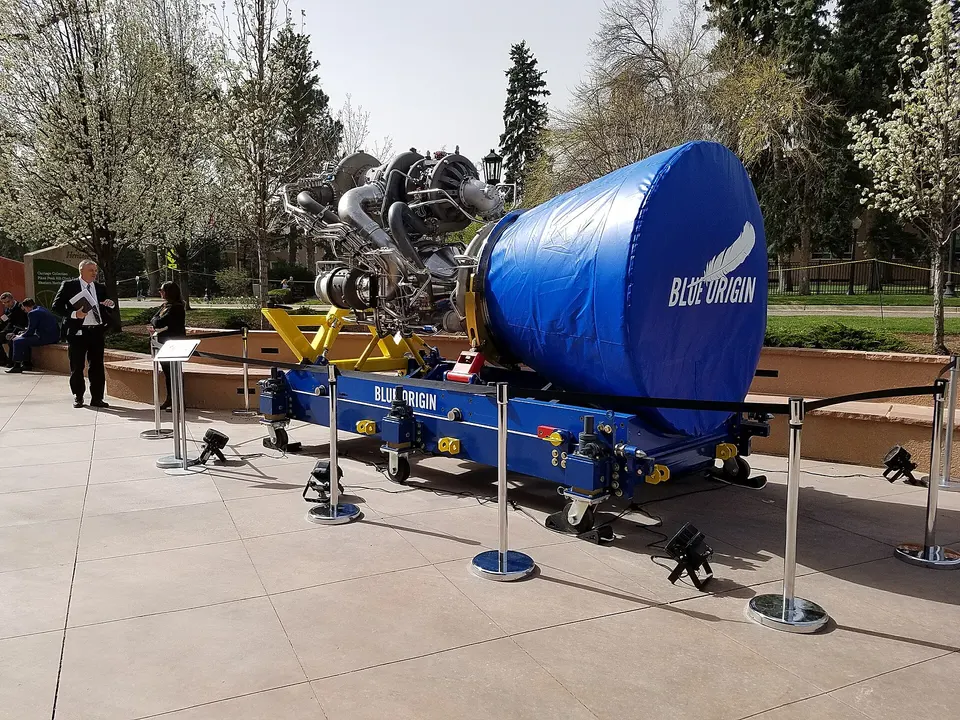
Ascent
Seven BE-4s
Seven BE-4 engines burn liquefied natural gas and oxygen. Methane leaves little soot, unlike kerosene, so engines need less cleaning between flights.
Upper stage
Hydrogen for high orbits
Two hydrogen engines power the upper stage. Hydrogen gives the most push per kg of fuel, suiting high orbits and deep space, but needs bulky tanks.
Landing
Fins steer it to a ship landing
The booster steers with fins on the way down, then relights its engines to land on the ship Jacklyn far out at sea.
Spec sheet
| Spec | New Glenn |
|---|---|
| Height | 98 mR (reported) |
| Diameter | 7 mR (reported) |
| First-stage engines | 7 × BE-4 (LNG/LOX)R (reported) |
| Second-stage engines | 2 × BE-3U (LH2/LOX)R (reported) |
| Liftoff thrust | ~17,100 kN (3.85 Mlbf)R (reported) |
| Payload to LEO | 45 tR (reported) |
| Booster design life | 25+ flightsR (reported) |
R reported by the company
Peer comparison
| Spec | New Glenn | Rocket Lab Neutron | SpaceX Starship |
|---|---|---|---|
| Height | 98 mR (reported) | 43 mR (reported) | — |
| Diameter | 7 mR (reported) | — | 9 mR (reported) |
| First-stage engines | 7 × BE-4 (LNG/LOX)R (reported) | 9 × ArchimedesR (reported) | — |
| Payload to LEO | 45 tR (reported) | — | 100+ tR (reported) |
R reported by the company
Papers & demos
- 13 Nov 2025demoNew Glenn first-stage landing on Jacklyn (NG-2) (opens blueorigin.com)Second company to recover an orbital-class booster propulsively.
Update log
Thu 6 Aug
- Major: PressTest
Thu 28 May
- Major: PressTest
Sun 19 Apr
- Major: PressTest
Thu 20 Nov 2025
- Minor: BlogHardware
Thu 13 Nov 2025
- Major: LivestreamTest
Thu 16 Jan 2025
- Major: LivestreamTest
Mon 12 Sep 2016
- Minor: PressHardware
About Blue Origin
Blue Origin
New Glenn, BE-4 engines, Blue Moon lander
Jeff Bezos's space company. It builds the New Glenn rocket, the BE-4 engine (also used by ULA), the Blue Moon landers and New Shepard. It has a NASA contract for a crewed Moon lander and paused New Shepard in 2026 to focus on the Moon.
- New Glenn landed its booster on only its second flight (Nov 2025), but NG-3 left a customer satellite in a useless orbit (Apr 2026).
- A May 2026 test-firing explosion destroyed a New Glenn and badly damaged LC-36, its only pad.
- New Shepard is paused for at least two years to focus on Blue Moon; Tory Bruno joined from ULA in early 2026.
- Founded
- 200026 yrs
- Headquarters
- United States
- Status
- Private
- Valuation
- private
- Works in
- SpaceflightLaunch
- Coverage
- 3 programs · 17 updateslatest 6 Aug 2026checked 25 Sep
- Partners
- Rocket Lab