

Milestones
- Service launches in Austin with safety monitors22 Jun 2025+65 mo
originally 2020Complete. - Bay Area service with safety driversJul 2025Complete.
- Austin opens to the public18 Nov 2025Complete.
- First unsupervised rides in AustinJan 2026Complete.
- Unsupervised expansion to Dallas and Houston18 Apr 2026Complete.
- Launches in Miami, then Orlando and Tampa21 Jul 2026Complete.
- Cybercab joins the Austin fleet3 Sep 2026Complete.
- Expand unsupervised fleet and citiesNowCurrent milestone.
Most important updates
- 3 Sep 2026
- 21 Jul 2026
- 18 Apr 2026
- 22 Jan 2026
- 22 Jun 2025
Upcoming
- Q4 2026Further unsupervised city launches and fleet growth (next)
Current obstacles
- Early driving errorsVideos from the 2025 launch showed wrong-lane driving, phantom braking and unsafe drop-offs, prompting inquiries by US safety regulator NHTSA.
- Permits outside Texas and FloridaCalifornia and other states require permits for paid driverless rides that Tesla does not yet hold.
Physics limits
- Cameras infer depth, they don't measure itA camera records light, not distance, so depth is estimated by the network. Low sun, glare, fog or dirty lenses can blind it, and there's no second sensor type to cross-check.
- Proving safety takes vast mileageUS drivers average about one fatal crash per 100 million miles. Showing a robot driver is safer with statistical confidence takes hundreds of millions of driverless miles (RAND estimated ~275M).
- Learned drivers can't be fully verifiedA neural network's behaviour in situations it never saw can't be proven in advance. Safety must be shown with testing and statistics, not formal guarantees.
How it works
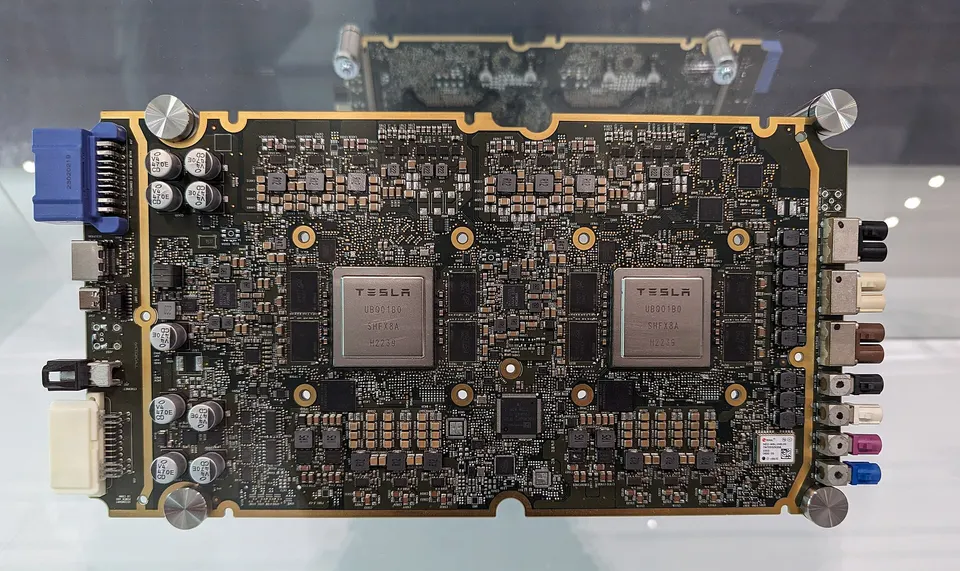
Perception
Eight cameras
Cameras around the car feed a neural network that builds a picture of the scene and guesses where other road users will move.
Driving
One network drives
The same network outputs steering, braking and speed, trained on huge amounts of human and fleet driving.
Operations
Geofence and remote help
Cars drive only inside mapped service areas; remote operators can help when a car is confused.
Spec sheet
| Spec | Tesla Robotaxi |
|---|---|
| Unsupervised vehicles | ~200 (Sep 2026)R (reported) |
| Unsupervised miles | 1M+ (Sep 2026)R (reported) |
| Unsupervised cities | 6R (reported) |
| Cameras per car | 8R (reported) |
| Lidar / radar | None (vision only)R (reported) |
R reported by the company
Update log
Thu 3 Sep
- Minor: PressCommercial
Tue 21 Jul
- Minor: PressCommercial
Sat 18 Apr
- Major: PressCommercial
Thu 22 Jan
- Major: PressCommercial
Tue 18 Nov 2025
- Minor: PressCommercial
Mon 23 Jun 2025
- Minor: PressRegulatory
Sun 22 Jun 2025
- Major: PressCommercial
About Tesla
Tesla
EVs, FSD, Robotaxi, Cybercab, Optimus
Tesla makes electric cars and batteries and is betting on self-driving: camera-only Full Self-Driving software, a Robotaxi service with no safety monitors in several Texas and Florida cities, the two-seat Cybercab, and the Optimus humanoid robot.
- Robotaxi went from a supervised Austin pilot (June 2025) to rides with no safety monitor in six Texas and Florida cities by July 2026.
- Cybercab, with no steering wheel or pedals, began low-rate production in Texas and started rolling out in Austin on 3 Sept 2026.
- Fremont's Model S/X line ended in May 2026 and is being turned into the first Optimus production line.
- Founded
- 200323 yrs
- Headquarters
- United States
- Status
- Public
- Listed
- TSLA (opens google.com)NASDAQ
- Valuation
- public
- Coverage
- 4 programs · 29 updateslatest 4 Sep 2026checked 25 Sep
- Partners
- SpaceX
- People
- Elon Musk (opens en.wikipedia.org)CEOVaibhav Taneja (opens en.wikipedia.org)CFOAshok ElluswamyVP, AI Software