
Milestones
- Neutron announced1 Mar 2021Complete.
- Launch pad at Wallops openedAug 2025Complete.
- First-stage tank fails in a ground testJan 2026Complete.
- First launchTarget Q4 2026+33 mo
originally 2024Current milestone. - First booster return and landingNot yet reached.
Most important updates
- Jan 2026
- 11 Nov 2025
- Aug 2025
- Aug 2024
- 4 Nov 2022
Upcoming
- Q4 2026First launch+33 mo
originally 2024(next)
Current obstacles
- Carbon-fibre tanks for super-cold fuelCarbon-fibre tanks holding super-cold oxygen can crack and leak over many uses; the Jan 2026 tank failure shows the risk.
- First-flight riskA new engine, airframe and pad make an early failure likely; each failure costs months.
Physics limits
- The rocket equation makes payload a sliver of launch massOrbit needs about 9.4 km/s of speed change including losses. Fuel needed grows exponentially with that, so even the best rockets put only 2 to 5% of their liftoff mass into low orbit.
- Every kilogram used to come home is a kilogram not carriedA returning booster keeps fuel for boostback and landing, plus legs or fins; this costs roughly 25 to 40% of payload versus throwing it away. Upper stages pay even more, since they are going at orbital speed.
- Engines run at the edge of what metals surviveBig engines burn at 3,000+ °C and hundreds of bar; hot, oxygen-rich gas in the pumps can set metal on fire. Chamber pressure and reuse are capped by cooling and alloys, not by design effort.
How it works
Airframe
Wide-bottomed carbon stage
The first stage widens toward the base so it falls steadily and lands on legs; carbon-fibre tanks keep it light.
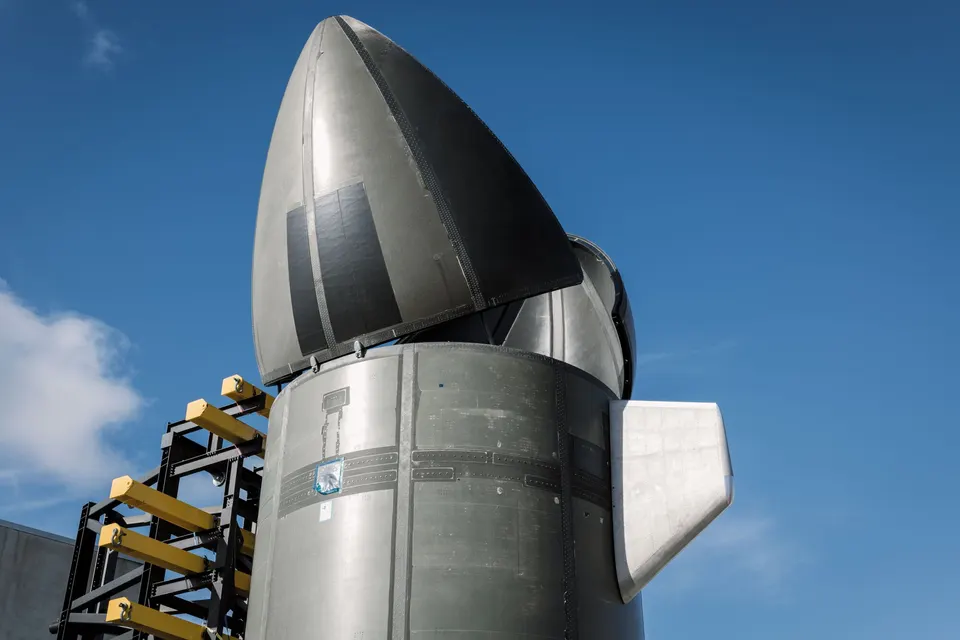
Fairing
Hungry Hippo
The nose fairing is part of the booster: it opens in space to release the upper stage, then closes and flies home with it, so only the upper stage is lost.
Engine
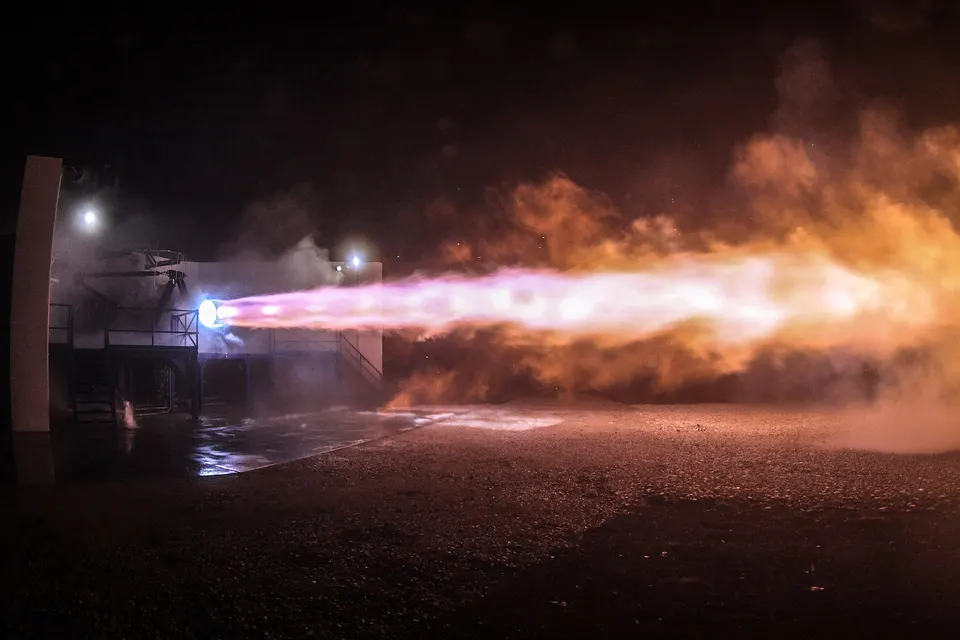
Archimedes
A methane engine run at moderate pressure instead of pushing its limits. Less stress on parts means it can fly many times with little rework.
Spec sheet
| Spec | Neutron |
|---|---|
| Height | 43 mR (reported) |
| Base diameter | 7 mR (reported) |
| First-stage engines | 9 × ArchimedesR (reported) |
| Archimedes thrust | ~165,000 lbf (~730 kN)R (reported) |
| Payload to LEO (reusable) | 13 tR (reported) |
| Propellant | Liquid methane / liquid oxygenR (reported) |
R reported by the company
Peer comparison
| Spec | Neutron | Blue Origin New Glenn |
|---|---|---|
| Height | 43 mR (reported) | 98 mR (reported) |
| First-stage engines | 9 × ArchimedesR (reported) | 7 × BE-4 (LNG/LOX)R (reported) |
R reported by the company
Update log
Jan 2026
- Major: PressTest
Tue 11 Nov 2025
- Major: PressOther
Aug 2025
- Minor: PressManufacturing
Aug 2024
- Major: PressTest
Fri 4 Nov 2022
- Minor: PressManufacturing
About Rocket Lab
Rocket Lab
Electron, Neutron, satellites, parts
Rocket Lab flies the small Electron rocket from New Zealand and Virginia and is building the reusable, bigger Neutron. It also builds satellites and satellite parts, and US military satellites.
- Electron is the second most-flown US-operated orbital rocket after Falcon 9.
- Neutron's first flight slipped to no earlier than Q4 2026 after a tank failed in testing in Jan 2026.
- Satellites and parts make most of its money; it built NASA's ESCAPADE Mars probes.
- Founded
- 200620 yrs
- Headquarters
- United StatesNew Zealand
- Status
- Public
- Listed
- RKLB (opens google.com)NASDAQ
- Valuation
- public
- Works in
- SpaceflightLaunch
- Coverage
- 2 programs · 12 updateslatest 29d agochecked 25 Sep
- Partners
- Blue Origin
- People
- Peter Beck (opens en.wikipedia.org)Founder and CEO