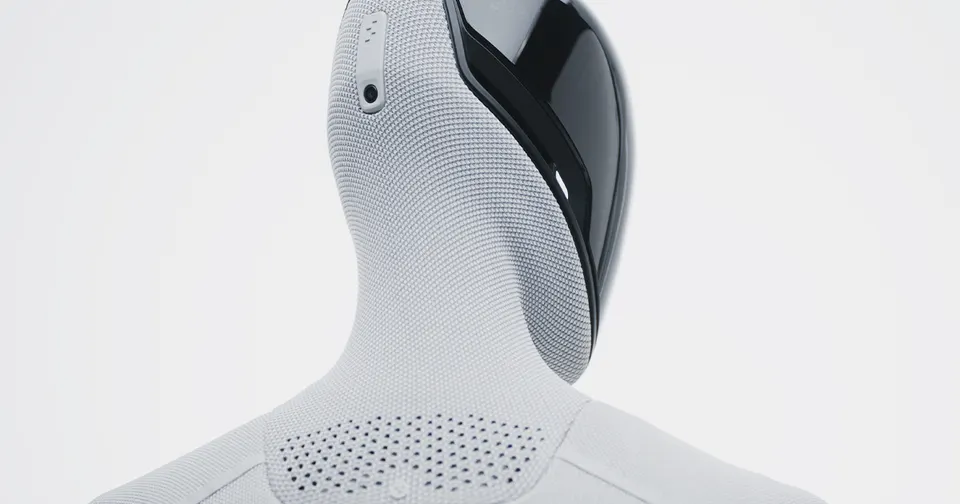

Milestones
- Figure 01 revealedMar 2023Complete.
- Commercial agreement with BMW Manufacturing18 Jan 2024Complete.
- Figure 02 unveiled6 Aug 2024Complete.
- Figure 03 unveiled9 Oct 2025Complete.
- Figure 02 retired from BMW after ~11 months, 30,000+ cars19 Nov 2025Complete.
- 350+ Figure 03 units delivered29 Apr 2026Complete.
- Figure 03 arrives at BMW Spartanburg for parts sequencing30 Jun 2026Complete.
- Scale multi-site fleet deploymentsNowCurrent milestone.
Most important updates
- 30 Jun 2026
- 26 May 2026
- 19 Nov 2025
- 9 Oct 2025
- 18 Jan 2024
Upcoming
- 2027BotQ's first line approaches its 12,000-robot annual design capacity (next)
Current obstacles
- Skilled hands at factory speedSmall screws, cables and floppy parts are still hard at factory speed. Success drops on new parts without more training data.
- Runtime versus weightBatteries limit shift length. Each extra kilo of battery costs strength and safety margin, so charging plans matter.
- Cost at scaleA humanoid must cost about what a worker costs per year. Cheaper parts help, but making them reliably at volume is unproven.
Physics limits
- Batteries cap the shiftLithium-ion cells store roughly 250 Wh per kg. A walking humanoid draws hundreds of watts, so a few hours of work needs several kilos of battery, and every extra kilo costs energy to carry.
- Electric motors are weak for their weight at low speedMotors spin fast but make little torque, so each joint needs a gearbox that multiplies force 10 to 100 times. Gearing adds friction, backlash and fragility when the robot bumps into things.
- Heat limits sustained strengthMotor heating grows with the square of the current. A joint can hit peak torque briefly, but holding heavy loads all shift overheats the windings unless the motor is oversized.
How it works
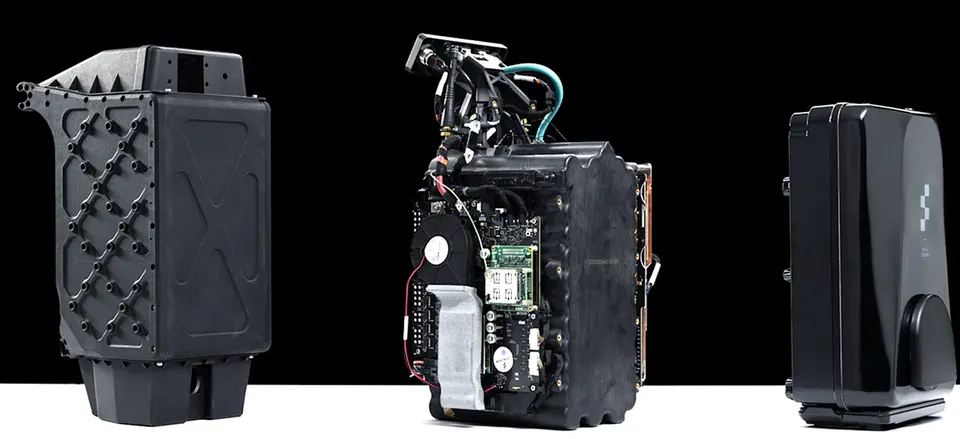
Electric joints, lighter frame
Electric actuators move the joints, 2x faster than Figure 02's. The body is 9% lighter and wrapped in soft, washable fabric.
Touch and palm vision
Fingertips feel about 3 grams of force. Palm cameras see inside the grip, so the robot can notice things slipping.
Helix onboard
A slow AI model plans. A fast one moves the joints 200 times a second. Helix 02 adds whole-body control, so it can work while stepping.
Battery and wireless charging
A torso battery powers it. Coils in the feet charge at 2 kW when it stands on a pad, so no one has to plug it in.
Spec sheet
| Spec | Figure 03 | Figure 02 | Change |
|---|---|---|---|
| Mass vs Figure 02 | 9% lowerR (reported) | — | —no comparable change |
| Weight | ~64 kgE (estimated) | 70 kg | ▼ 6 kg |
| Fingertip sensitivity | ~3 gR (reported) | — | —no comparable change |
| Wireless charging | 2 kW inductive, through the feetR (reported) | Cable dock | —no comparable change |
| Camera frame rate | 2x Figure 02R (reported) | — | —no comparable change |
| Camera latency | 1/4 of Figure 02R (reported) | — | —no comparable change |
| Field of view per camera | 60% widerR (reported) | — | —no comparable change |
| Data offload | 10 Gbps mmWaveR (reported) | — | —no comparable change |
| Hand DoF | 16 per hand (Figure 02)R (reported) | — | —no comparable change |
R reported by the company · E our estimate
Papers & demos
- 25 Mar 2025blogNatural humanoid walk using reinforcement learning (opens figure.ai)A walking skill trained only in simulation worked straight away on a fleet of real robots.
Update log
Tue 30 Jun
- Major: BlogCommercial
Tue 26 May
- Minor: BlogCommercial
Wed 19 Nov 2025
- Major: BlogCommercial
Thu 9 Oct 2025
- Major: BlogHardware
Thu 18 Jan 2024
- Major: PressCommercial
About Figure
Figure
Humanoids, Helix AI, BotQ factory
Figure builds electric humanoid robots and Helix, the AI that controls them. Founded in 2022 by Brett Adcock, its robots work at BMW's Spartanburg plant, and in 2026 its BotQ factory built about 1 robot per hour.
- Figure 02 worked about 11 months at BMW Spartanburg. Figure 03 arrived there in June 2026.
- All its AI is in-house: Helix (Feb 2025), Helix 02 (Jan 2026) and Helix 2.5 (Sep 2026).
- BotQ went from 1 robot a day (Jan 2026) to 1 an hour (Apr 2026). First line: 12,000 robots a year.
- Founded
- 20224 yrs
- Headquarters
- United States
- Status
- Private
- Valuation
- $39BprivateSep 2025
- Staff
- ~600Jan 2025
- Raised
- $1.7B3 rounds
- Last round
- Series C · $1B16 Sep 2025$39B post
- Works in
- RoboticsHumanoidsAIManufacturing
- Coverage
- 3 programs · 15 updateslatest 23d agochecked 25 Sep
- Lead investors
- Parkway Venture Capital
- Investors
- NVIDIA
- Suppliers
- Nscale (opens nscale.com)
- People
- Brett Adcock (opens en.wikipedia.org)Founder & CEOCorey Lynch (opens coreylynch.github.io)Head of AI (Helix)