
Milestones
- ExcelsiusGPS FDA 510(k) clearance2017Complete.
- Reaches 10,000 surgical cases2021Complete.
- Widespread hospital adoption and use across spine surgery centers2024Complete.
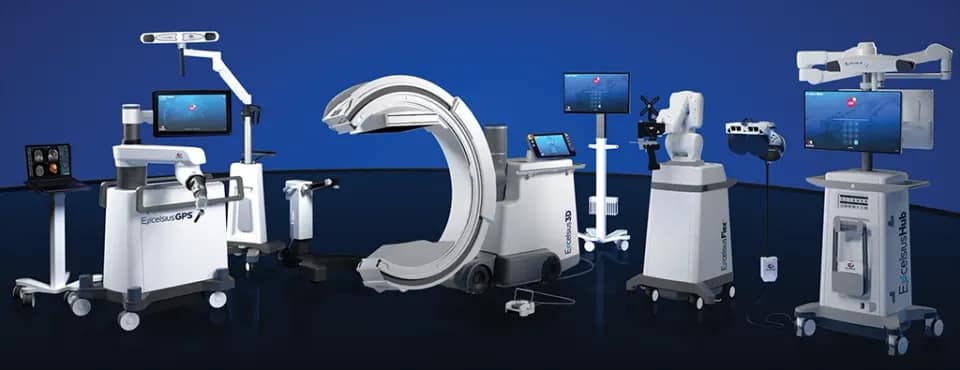
ExcelsiusGPS combines a rigid arm with full intraoperative navigation for spine and orthopedic surgery. Surgeons achieve millimeter precision in implant placement with reduced radiation.
Deployed at hospitals globally. FDA-cleared for spine and orthopedic surgery.
Updated 2017Checked 10 Oct0 updates this week
Surgeons use preoperative CT scans to plan surgical trajectories for screw placement with millimeter-level precision.
The rigid robotic arm guides the surgeon's instruments along the planned trajectory, adjusting in real-time as the patient shifts during the procedure.
ExcelsiusGPS works with any preoperative CT, intraoperative CT, or fluoroscopy, so surgeons can use whichever imaging is available in their OR.
The surgeon performs the actual screw insertion guided by the robotic arm, not autonomous; the robot enhances precision but does not replace surgeon judgment.
| Spec | ExcelsiusGPS |
|---|---|
| Surgical precision capability | Sub-millimeter accuracy in implant placementR (reported) |
R reported by the company
Globus Medical
ExcelsiusGPS surgical navigation, spine robotics
Globus Medical makes musculoskeletal devices and the ExcelsiusGPS robotic navigation platform for spine and orthopedic surgery. NYSE-listed (GMED) since 2009.
globusmedical.com (opens globusmedical.com)Company profile →