
Milestones
- Toroidal Field Model Coil reaches 20 T5 Sep 2021Complete.
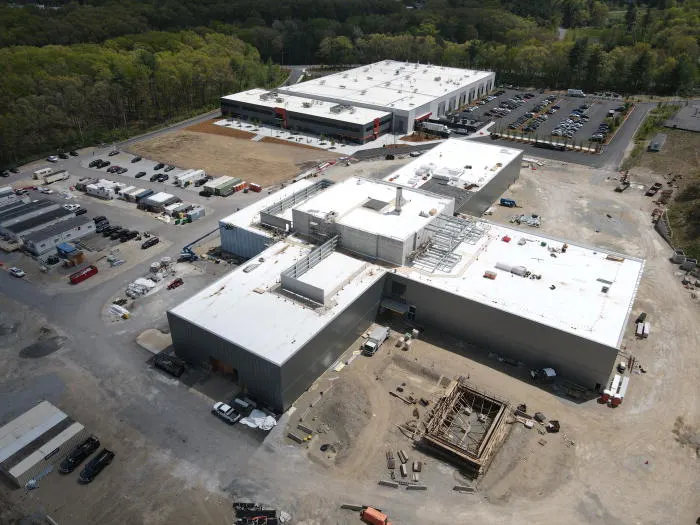
- Construction of SPARC facility begins in Devens, MA2021Complete.
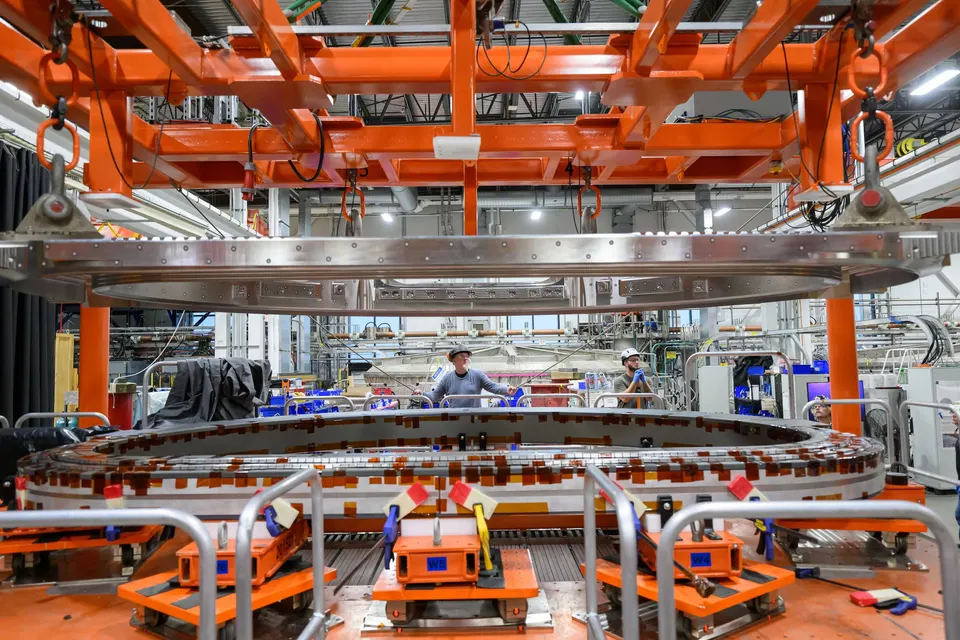
- First production toroidal field magnet completed2025Complete.
- First of 18 main (toroidal field) magnets installedJan 2026Complete.
- All 18 main magnets installedTarget 2026Current milestone.
- First plasmaTarget 2027+24 mo
originally 2025Not yet reached. - Q>1: more fusion power out than heating power inTarget 2027Not yet reached.
Most important updates
- May 2026
- 6 Jan 2026
- Oct 2025
- Mar 2025
- 8 Sep 2021
Upcoming
- 2026All 18 main magnets installed (next)
- 2027First plasma+24 mo
originally 2025 - 2027Q>1: more fusion power out than heating power in
Current obstacles
- Tight assembly tolerancesEighteen 20-tonne-class magnets must line up to the millimetre and take huge forces; small errors weaken the magnetic bottle.
- Protecting magnets from a quenchIf part of a magnet stops superconducting, its stored energy must be dumped fast before it damages the coil. HTS tape makes this harder to spot.
- Handling exhaust heatWaste heat is funnelled onto small surfaces at tens of MW per square metre. Taking that without melting tungsten is a first.
Physics limits
- Nuclei repel, so fuel must be ~100 million °CDeuterium and tritium nuclei are both positive. Only above ~100 million °C do enough collide hard enough to fuse, and gain needs density × heat × confinement time above the Lawson threshold.
- Plasma pressure is capped by the magnetic fieldA tokamak holds plasma at only a few per cent of the magnetic pressure before it goes unstable. Fusion power rises with field to the 4th power, but coil forces rise with field squared.
- Superconductors sit a metre from the hottest thing on EarthThe HTS tape must stay near -250 °C while neutrons from the plasma heat and damage it. Every centimetre of shielding makes the machine bigger, eroding the compact design.
How it works
A doughnut-shaped magnetic bottle
Eighteen D-shaped magnets hold 100-million-degree fuel away from the walls long enough for atoms to fuse.
Stronger magnets, smaller machine
Fusion power rises steeply with field strength. At 12.2 T, a 1.85 m SPARC can aim for gain like ITER, which is 6.2 m.
Radio waves heat the plasma
Radio waves heat the fuel. Once fusion starts, the helium it makes keeps heating the plasma, which allows high gain.
Neutrons carry the energy out
80% of the energy leaves as fast neutrons. SPARC measures them to prove gain; turning heat into power is ARC's job.
Spec sheet
| Spec | SPARC |
|---|---|
| Major radius | 1.85 mR (reported) |
| Minor radius | 0.57 mR (reported) |
| Toroidal field on axis | 12.2 TR (reported) |
| Peak field on coil (TFMC test) | 20 TR (reported) |
| Plasma current | 8.7 MAR (reported) |
| Fusion power (design) | ~140 MWR (reported) |
| Predicted fusion gain Q | ~11 (goal Q>1)R (reported) |
| Flat-top pulse length | ~10 sR (reported) |
| Toroidal field coils | 18 HTS coilsR (reported) |
R reported by the company
Papers & demos
- Mar 2024paperCore performance predictions in projected SPARC first-campaign plasmas with nonlinear CGYRO (opens arxiv.org)Detailed plasma simulations backing the prediction that SPARC's first campaign can reach Q>1.
- Aug 2023paperThe SPARC Toroidal Field Model Coil Program (opens arxiv.org)Detailed engineering report on the magnet test, including how it behaved when it lost superconductivity.
- Sep 2021demoToroidal Field Model Coil reaches 20 T (opens cfs.energy)First big HTS magnet at fusion-level field, removing the main risk of the compact approach.
- Sep 2020paperOverview of the SPARC tokamak (Journal of Plasma Physics special issue) (opens doi.org)Seven peer-reviewed papers on SPARC's design, predicting a fusion gain of ~11 using standard physics.
Update log
May 2026
- Minor: PressHardware
Tue 6 Jan
- Major: PressHardware
Oct 2025
- Minor: PressTest
Mar 2025
- Major: PressHardware
Wed 8 Jan 2025
- Minor: BlogManufacturing
Wed 8 Sep 2021
- Major: PressTest
About Commonwealth Fusion Systems
Commonwealth Fusion Systems
HTS magnets, SPARC tokamak, ARC power plant
MIT spinout building small, powerful tokamaks with high-temperature superconducting (HTS) magnets. SPARC in Massachusetts aims to make more fusion power than it takes in; ARC in Virginia aims to sell power in the early 2030s.
- Proved a record 20 tesla HTS fusion magnet in 2021, the key to a much smaller tokamak.
- Installing SPARC's 18 main magnets in 2026; first plasma targeted for 2027.
- Raised about $3B; Google and Eni have agreed to buy power from its planned ARC plant.
- Founded
- 20188 yrs
- Headquarters
- United States
- Status
- Private
- Valuation
- private
- Raised
- $2.8B3 rounds
- Last round
- Series B2 · $863MAug 2025
- Coverage
- 2 programs · 15 updateslatest 30 Jul 2026checked 25 Sep
- Lead investors
- Tiger Global Management
- Partners
- MIT Plasma Science and Fusion Center (opens psfc.mit.edu)Dominion Energy Virginia (opens dominionenergy.com)NVIDIA
- People
- Bob MumgaardCo-founder & CEOBrandon SorbomCo-founder & Chief Science OfficerDennis Whyte (opens psfc.mit.edu)Co-founder; MIT professor of nuclear science