
The brief
- Its largest pilot run, in early 2025, made about a tonne of steel in an industrial-size cell.
- In 2026 it closed its Woburn site (71 layoffs) and refocused on critical metals in Brazil, where revenue is nearer.
- Raised $75M in May 2026 with Tata Steel joining; total funding is above $500M.
Technical approach
Chemistry
Electricity splits molten ore
Ore dissolves in a molten bath at about 1,600 °C. Electric current makes liquid metal pool at the bottom while oxygen gas bubbles off.
Anode
An electrode that survives
Similar processes burn up carbon electrodes and emit CO2. MOE needs one that survives 1,600 °C and oxygen; its own anode design is the core IP.
Scale
Add cells, not furnaces
Output grows by adding more cells, so one design can serve both big steel and small critical-metal markets.
Programs
Boston Metal, one program
Updated 20 May 2026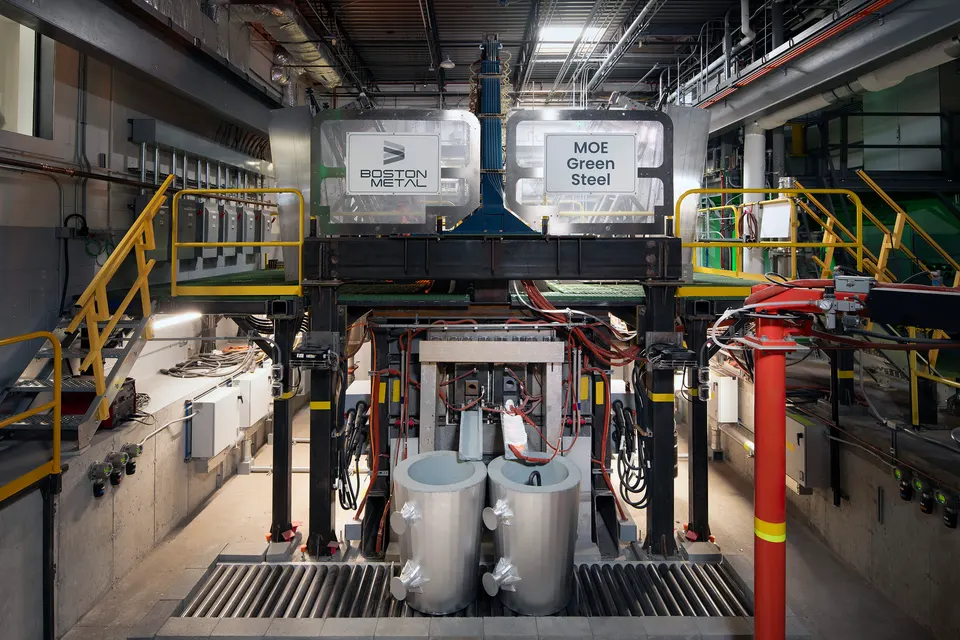
Research · Proto · Pilot · Deploy · Scaling
Research & demos
- May 2013paperA cost-effective anode for molten oxide electrolysis (Nature, Allanore, Yin & Sadoway) (opens doi.org)Molten oxide electrolysis (MOE)
Showed a chromium-based alloy anode that resists oxidation: the science behind MOE.
Open technical problems
- Anode lifetime at scaleActive research
The anode must last long in full-size cells for the economics to work; that isn't publicly proven yet.
- Electricity cost for steelOpen
All the energy comes from electricity, so MOE steel only competes where clean power is cheap and plentiful.
Peers
Company & funding
- Raised
- $245Mdisclosed private rounds
- Last round
- Growth round20 May 2026
- HQ
- US
- Founded
- 2012
| Date | Round | Amount | Post-money | Lead |
|---|---|---|---|---|
| 20 May 2026 | Growth round | $75M | — | — |
| Jan 2023 | Series C | $120M | — | — |
| Sep 2021 | Series B | $50M | — | Breakthrough Energy Ventures |
Partners & customers
- Investor
Invested in the 2023 Series C.
- Investor
Joined the May 2026 round.
- Investor