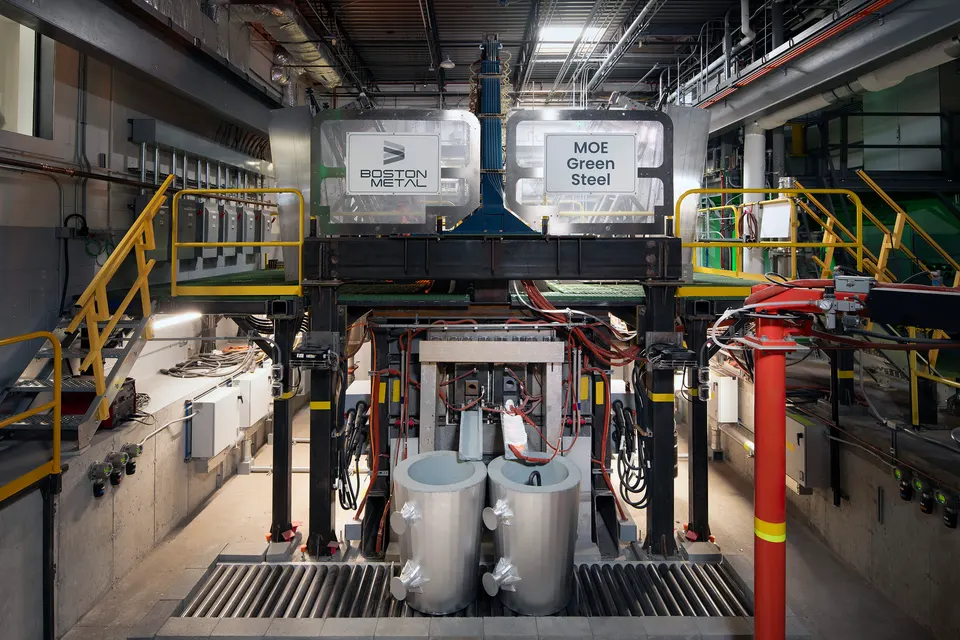

Milestones
- Inert anode paper in NatureMay 2013Complete.
- Largest pilot run: ~1 tonne of steelQ1 2025Complete.
- Woburn operations closed; refocus on BrazilMar 2026Complete.
- Industrial-scale critical metals plant in BrazilNowCurrent milestone.
- Commercial green steel demonstrationNot yet reached.
Most important updates
- 20 May 2026
- 24 Feb 2026
- 9 Sep 2025
- 12 Mar 2025
Current obstacles
- Scaling cell sizeCurrent, heat balance and anode wear all change as cells grow toward steel-industry size.
Physics limits
- The anode must survive 1,600 °C oxygenThe anode sits in molten oxide while oxygen gas bubbles off it; nearly every metal oxidises or dissolves there, so an inert anode needs rare, carefully tuned alloys.
- Splitting iron oxide has a fixed energy costThermodynamics sets a floor of about 2 MWh to free a tonne of iron from its oxide; keeping the bath molten and cell losses add more, so cheap clean power is essential.
How it works
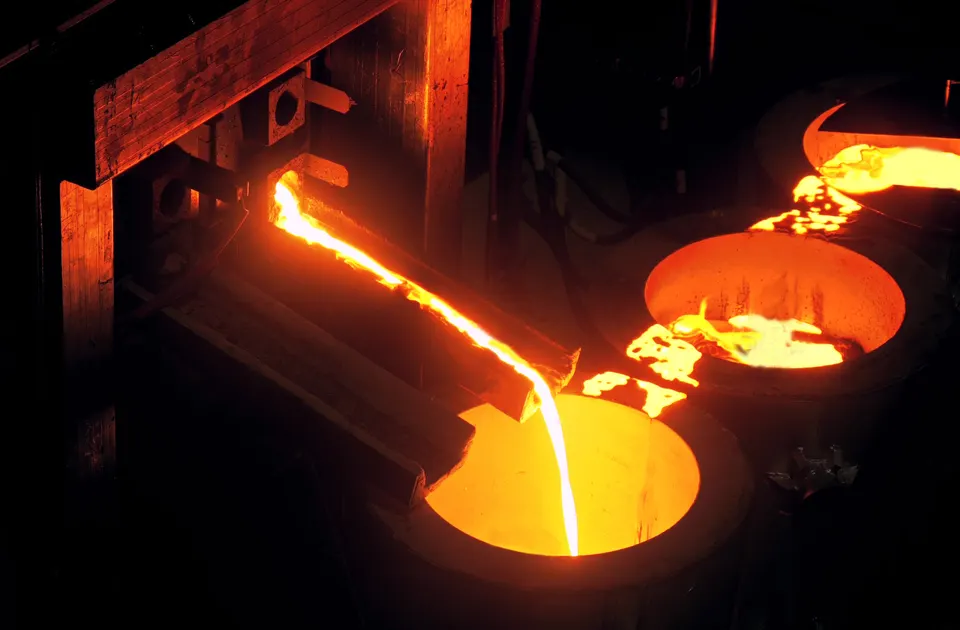
Dissolve
Molten bath
Ore dissolves in a bath of molten oxide at about 1,600 °C, partly heated by the current itself.
Reduce
Metal at the bottom
Metal collects as a liquid at the bottom of the cell, where it can be tapped off.
Oxygen
Oxygen at the anode
At the anode, oxygen gas forms. It is the only by-product.
Spec sheet
| Spec | Molten oxide electrolysis (MOE) |
|---|---|
| Operating temperature | ~1,600 °CR (reported) |
| Largest pilot run | ~1 t steelR (reported) |
R reported by the company
Papers & demos
- May 2013paperA cost-effective anode for molten oxide electrolysis (Nature, Allanore, Yin & Sadoway) (opens doi.org)Showed a chromium-based alloy anode that resists oxidation: the science behind MOE.
Update log
Wed 20 May
- Minor: PressFunding
Tue 24 Feb
- Major: PressPeople
Tue 9 Sep 2025
- Minor: PressPartnership
Wed 12 Mar 2025
- Major: PressTest
About Boston Metal
Boston Metal
Electric steelmaking, critical metals from mining waste
Boston Metal, an MIT spinout, uses molten oxide electrolysis (MOE): electricity splits molten ore into liquid metal and oxygen. It targets CO2-free steel and, via a Brazilian unit, niobium and tantalum from mining waste.
- Its largest pilot run, in early 2025, made about a tonne of steel in an industrial-size cell.
- In 2026 it closed its Woburn site (71 layoffs) and refocused on critical metals in Brazil, where revenue is nearer.
- Raised $75M in May 2026 with Tata Steel joining; total funding is above $500M.
- Founded
- 201214 yrs
- Headquarters
- United States
- Status
- Private
- Valuation
- private
- Raised
- $245M3 rounds
- Last round
- Growth round · $75M20 May 2026
- Works in
- MaterialsGreen steel
- Coverage
- 1 program · 5 updateslatest 20 May 2026checked 25 Sep
- Lead investors
- Breakthrough Energy Ventures
- Investors
- ArcelorMittal (opens bostonmetal.com)Tata Steel (opens tatasteel.com)Breakthrough Energy Ventures (opens breakthroughenergy.org)
- People
- Tadeu Carneiro (opens bostonmetal.com)CEODonald Sadoway (opens en.wikipedia.org)Co-founderAntoine Allanore (opens dmse.mit.edu)Co-founder