

Milestones
- Ion-photon entanglement between separate systemsNowCurrent milestone.
Most important updates
- 19d ago
- Jul 2025
Current obstacles
- Photon collection efficiencyOnly a small share of the photons ions emit are caught into fibre, which slows links between machines.
Physics limits
- Fibre loses photons and they can't be amplifiedTelecom fibre loses about 0.2 dB per km, so after 100 km only about 1% of photons arrive. Quantum states can't be copied (no-cloning theorem), so ordinary signal amplifiers can't help.
- Ions emit the wrong colourBarium ions emit visible light (493 nm) that fibre absorbs strongly. Converting it to telecom wavelengths loses photons, and optics collect only a fraction of the light a single atom emits.
- Beams from orbit spread outDiffraction widens a beam from a 30 cm telescope to a few metres over 1,000 km, so only a small fraction of photons from a satellite reach a ground telescope, and clouds block them entirely.
How it works
Link
Ion-photon entanglement
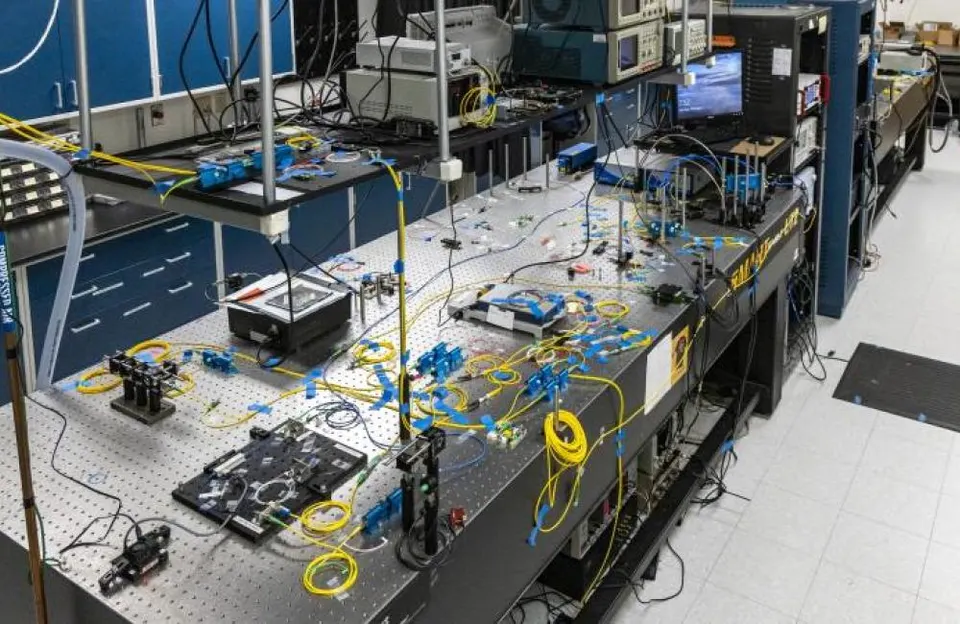
An ion is excited so it emits one photon entangled with it. Photons from two systems meet at a detector, which links the two ions.
Memory
Quantum memory
Lightsynq's memories hold photons briefly so link attempts can be synchronised and retried, instead of both sides needing to succeed at once.
QKD
Keys carried by single photons
ID Quantique systems send encryption keys encoded in single photons. An eavesdropper disturbs them and is detected.
Update log
Mon 21 Sep
- Minor: PressPartnership
Jul 2025
- Minor: PressOther
About IonQ
IonQ
Trapped-ion computers, quantum networking, chip fab
IonQ builds trapped-ion quantum computers and was the first pure quantum company to go public (2021). Under CEO Niccolo de Masi it bought Oxford Ionics, networking firms and chip fab SkyWater. It aims for 2 million qubits by 2030.
- Closed its $1.8B purchase of chip maker SkyWater on 31 July 2026, gaining its own fab.
- Reported 99.99% two-qubit fidelity in October 2025 using Oxford Ionics' electronic control.
- Raised $2B in equity in October 2025, one of the sector's largest raises.
- Founded
- 201511 yrs
- Headquarters
- United States
- Status
- Public
- Listed
- IONQ (opens google.com)NYSE
- Valuation
- public
- Raised
- $3B2 rounds
- Last round
- Equity offering · $2BOct 2025
- Coverage
- 2 programs · 11 updateslatest 18d agochecked 25 Sep
- Lead investors
- Heights Capital Management
- Partners
- Oxford Ionics (opens oxionics.com)SkyWater Technology (opens skywatertechnology.com)ID Quantique (opens idquantique.com)
- People
- Niccolo de MasiChairman and CEOChris Monroe (opens en.wikipedia.org)Co-founder