

Milestones
- FDA Breakthrough status (Parkinson's)Aug 2023Complete.
- First human use (temporary), ManchesterSep 2024Complete.
- Permanent implant for Parkinson'sNowCurrent milestone.
Most important updates
- University of Manchester first-in-human study of graphene brain-mapping electrodes completes24 Jun 2026
- INBRAIN and Microsoft sign a collaboration on AI for precision neurology12 Nov 2025
- INBRAIN reports positive interim results from its first-in-human graphene interface studyJul 2025
- First human receives INBRAIN graphene brain interface during tumor surgery in ManchesterSep 2024
Current obstacles
- Will graphene last?Graphene devices must keep working safely in the body for years.
Physics limits
- Decades in salt water are untestedThe body is warm, salty and chemically active. Whether atom-thin graphene and its sealing layers stay intact for decades has not yet been shown.
- Tiny contacts are noisierShrinking a contact raises its electrical resistance and background noise. Graphene softens this rule but doesn't escape it.
- Small contacts pass little chargeEach contact can deliver only so much charge per pulse before harming tissue or itself, so very small contacts limit stimulation strength.
How it works
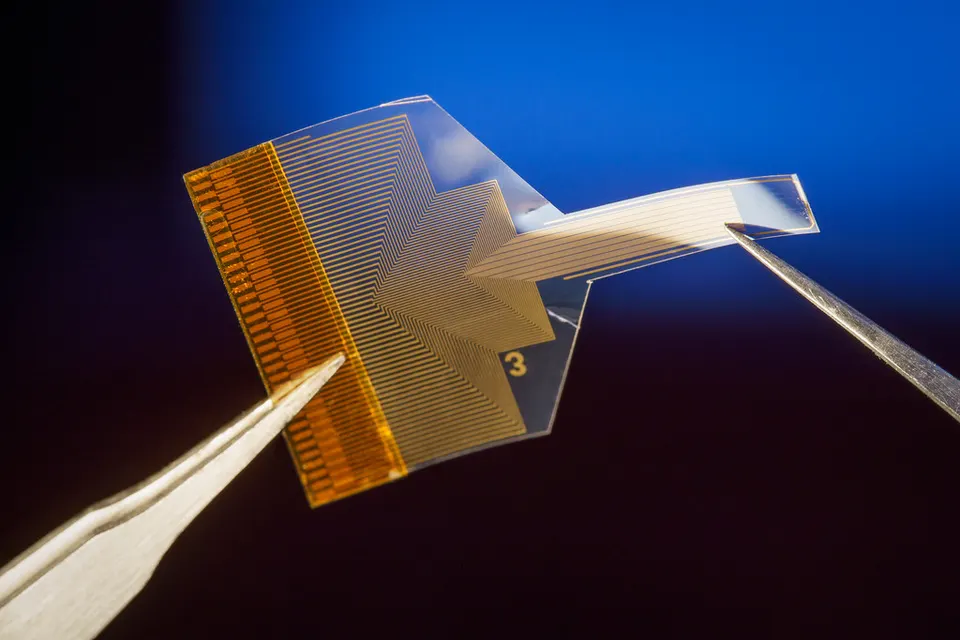
Carbon one atom thick
Graphene conducts electricity well and bends like film, so electrode contacts can be made far smaller than metal ones without losing signal.
A thin sheet on the brain
A flexible graphene sheet on the brain surface records activity at high resolution; the first human tests were during tumour surgery.
Stimulate only when needed
For Parkinson's, the system is meant to detect abnormal brain rhythms and stimulate precisely when and where they appear.
Update log
Wed 24 Jun
Wed 12 Nov 2025
- Minor: INBRAIN and Microsoft sign a collaboration on AI for precision neurologyPressPartnership
Jul 2025
Sep 2024
About INBRAIN Neuroelectronics
INBRAIN Neuroelectronics
Graphene brain electrodes, Parkinson's
Barcelona company making ultra-thin graphene electrodes to record and stimulate the brain and nerves. Graphene lets contacts be very small and bendy. First used in people during brain tumor surgery in Manchester; FDA Breakthrough status for Parkinson's.
- Its first human study began in Sep 2024 at the University of Manchester, placing the device briefly during tumor surgery.
- Raised a $50M Series B led by imec.xpand, bringing total funding to $68M.
inbrain-neuroelectronics.com (opens inbrain-neuroelectronics.com)Company profile →
- Founded
- 20197 yrs
- Headquarters
- Spain
- Status
- Private
- Valuation
- private
- Works in
- NeurotechStimulation therapies
- Coverage
- 1 program · 4 updateslatest 24 Jun 2026checked 25 Sep
- People
- Carolina AguilarCo-founder and CEO