

Milestones
- First-gen sodium-ion cell unveiled (160 Wh/kg)Jul 2021Complete.
- Naxtra brand launched at Tech DayApr 2025Complete.
- Volume production rampNowCurrent milestone.
- Passenger-car deploymentTarget 2026Not yet reached.
Most important updates
- 16 Jul 2026
- 22 Jun 2026
- 27 Apr 2026
- Feb 2026
- 21 Apr 2025
Upcoming
- 2026Passenger-car deployment (next)
- Jun 2027Tener Sodium storage system begins global rollout
Current obstacles
- Cost edge depends on lithium pricesWhen lithium gets cheap, sodium-ion's price edge over LFP shrinks and much of its case goes.
- Hard-carbon supply chainMaking hard carbon is far less mature than making graphite.
Physics limits
- Sodium is heavier and larger than lithiumSodium weighs 23 u to lithium's 7, its ion is ~30% larger, and its cells run ~0.3 V lower, so the best sodium cells reach ~175 Wh/kg, below good LFP and far below nickel cells.
- Graphite won't hold sodiumSodium does not form stable compounds with graphite, so anodes use disordered hard carbon, which stores less per gram and traps some sodium on the first charge.
How it works
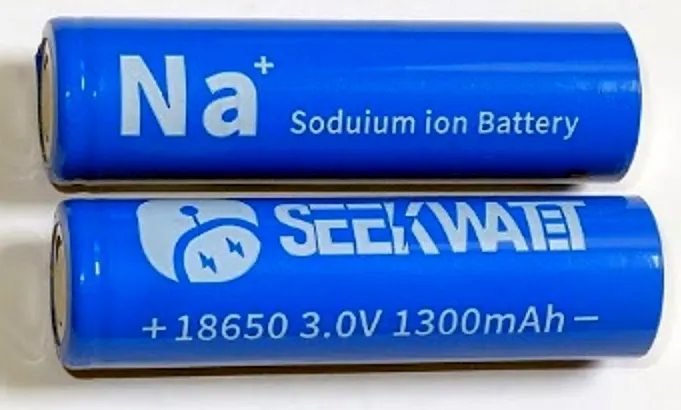
Ion
Sodium instead of lithium
Sodium ions shuttle between the two sides like lithium does, but they're bigger, so the electrodes are redesigned.
Anode
Hard carbon
Graphite can't hold sodium well; disordered 'hard' carbon has pores and defects that can.
Trade-off
Cheaper and safer, but less dense
Sodium doesn't alloy with aluminium, so cheap aluminium foil replaces copper at the anode; the trade-off is less energy per kilo, but better cold performance.
Spec sheet
| Spec | Naxtra sodium-ion | 1st-gen sodium-ion (2021) | Change |
|---|---|---|---|
| Cell energy density | 175 Wh/kgR (reported) | 160 Wh/kg | ▲ 15 Wh/kg |
| Cycle life | >10,000 cyclesR (reported) | — | —no comparable change |
| Operating temperature floor | -40 °CR (reported) | — | —no comparable change |
| Lithium content | NoneR (reported) | — | —no comparable change |
| Chemistry | Sodium-ion, hard-carbon anodeR (reported) | — | —no comparable change |
R reported by the company
Papers & demos
- Apr 2025demoTech Day 2025: Naxtra sodium-ion and Freevoy dual-chemistry packs (opens catl.com)Took sodium-ion from the lab into production vehicles.
Update log
Thu 16 Jul
- Minor: PressCommercial
Mon 22 Jun
- Minor: PressHardware
Sat 9 May
- Minor: PressManufacturing
Mon 27 Apr
- Major: PressCommercial
Feb 2026
- Major: PressCommercial
Mon 21 Apr 2025
- Major: PressHardware
About CATL
CATL
EV and grid batteries, LFP, sodium-ion, cell-to-pack
China's CATL is the world's largest battery maker, with over a third of the global EV battery market. It supplies Tesla, BMW, Volkswagen and most Chinese carmakers, and licenses LFP tech to Ford. Listed in Shenzhen and, since May 2025, Hong Kong.
- EV battery leader with ~37-38% global market share in 2024-2025 (SNE Research).
- Launched Naxtra, a lithium-free 175 Wh/kg sodium-ion cell, in April 2025 for cars and storage.
- Raised ~$4.6B in a May 2025 Hong Kong listing, partly to fund its plant in Debrecen, Hungary.
- Founded
- 201115 yrs
- Headquarters
- China
- Status
- Public
- Listed
- 300750 (opens google.com)SZSE
- Valuation
- public
- Coverage
- 2 programs · 14 updateslatest 16 Jul 2026checked 25 Sep
- Customers
- TeslaBMW (opens bmwgroup.com)
- People
- Robin Zeng (Zeng Yuqun) (opens en.wikipedia.org)Founder & Chairman