
Milestones
- WSE-1 unveiledAug 2019Complete.
- WSE-2 (7 nm, 2.6T transistors)Apr 2021Complete.
- WSE-3 (5 nm, 4T transistors)13 Mar 2024Complete.
- Cerebras Inference cloud launched27 Aug 2024Complete.
Most important updates
- 14 Jan 2026
- Apr 2025
- Mar 2025
- 27 Aug 2024
- 13 Mar 2024
Current obstacles
- Memory capacity per wafer44 GB of on-chip memory is fast but small, so big models must be split across many wafers.
Physics limits
- SRAM is fast but not denseOn-chip SRAM needs six transistors per bit and has barely shrunk on recent nodes. Even a whole wafer holds only 44 GB, so large models must be spread over many wafers or streamed in.
- A wafer is the largest possible chipWafers are 300 mm across, so the biggest square chip is about 46,000 mm². Beyond that, compute grows only by linking wafers, which brings back the slower off-chip links wafer-scale was meant to avoid.
- Defects are certain at this sizeEvery wafer has defects, so a wafer-sized chip must carry spare cores and route around failures. That redundancy costs area, and some fraction of wafers still has too many faults to use.
How it works
Wafer
One chip per wafer
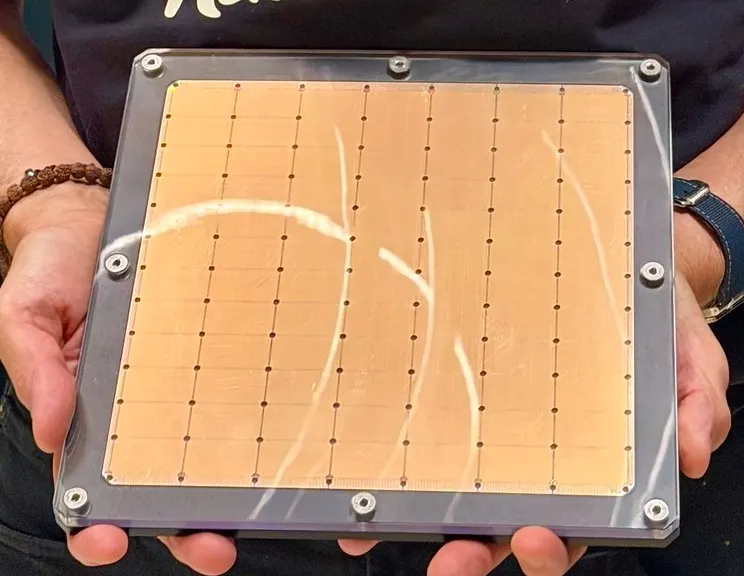
Instead of cutting a wafer into many chips, the whole 46,225 mm² square is one processor with about 900,000 cores and 4 trillion transistors.
Memory
Memory beside every core
44 GB of SRAM is spread among the cores, giving about 21 PB/s of bandwidth, so weights don't wait on external memory.
Defects
Built-in spares
Spare cores and rerouting let the chip work around the defects that every wafer has.
Scale
Streaming weights for training
For training, weights live in external MemoryX units and stream in layer by layer; SwarmX links many CS-3 systems.
Update log
Wed 14 Jan
- Major: BlogCommercial
Apr 2025
- Minor: PressPartnership
Mar 2025
- Minor: PressCommercial
Tue 27 Aug 2024
- Minor: BlogCommercial
Wed 13 Mar 2024
- Major: PressHardware
About Cerebras
Cerebras
Wafer-size AI chips, inference cloud
Cerebras builds an AI chip the size of a whole silicon wafer, and sells systems and a fast AI cloud. It listed on Nasdaq in May 2026 in one of the year's biggest tech IPOs.
- IPO priced at $185 per share on 14 May 2026, raising about $5.55B.
- WSE-3 packs 4 trillion transistors and 44 GB of on-chip memory on one wafer.
- Signed a multi-year inference deal with OpenAI in January 2026.
- Founded
- 201610 yrs
- Headquarters
- United States
- Status
- Public
- Listed
- CBRS (opens google.com)NASDAQ
- Valuation
- public
- Raised
- $1.1B1 round
- Last round
- IPO · $5.5BMay 2026
- Coverage
- 1 program · 7 updateslatest 14 May 2026checked 25 Sep
- Lead investors
- FidelityAtreides Management
- Customers
- OpenAIG42
- Suppliers
- TSMC
- People
- Andrew FeldmanCo-founder and CEO