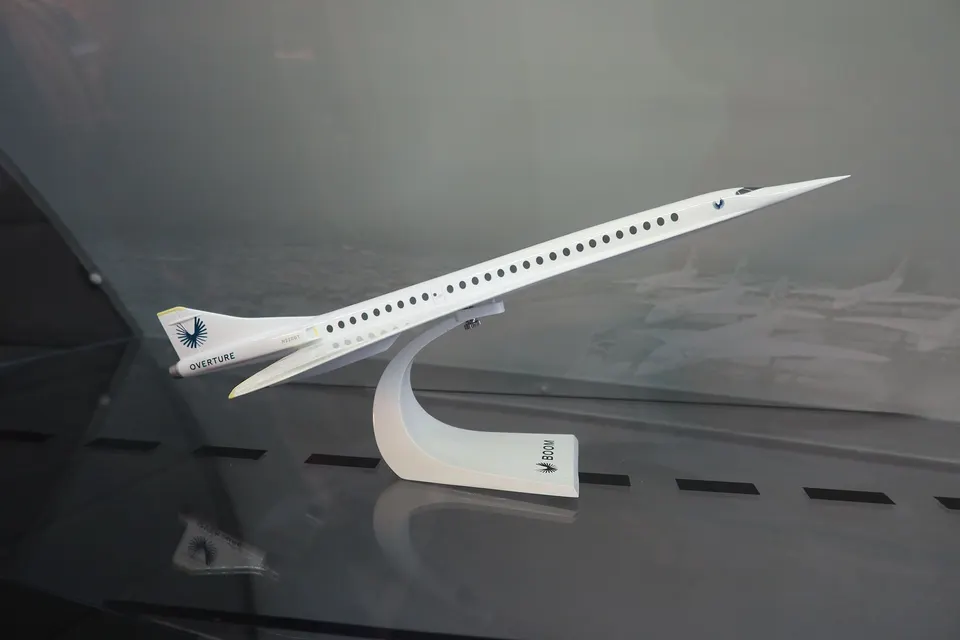

Milestones
- United Airlines orderJun 2021Complete.
- Overture Superfactory opens in GreensboroJun 2024Complete.
- XB-1 first flight22 Mar 2024Complete.
- XB-1 goes supersonic28 Jan 2025Complete.
- Symphony engine core testsTarget 2026Current milestone.
- Overture first flightNot yet reached.
- Entry into serviceNot yet reached.
Most important updates
- 6 Jun 2025
- 28 Jan 2025
- 23 Jul 2024
- 22 Mar 2024
- 13 Dec 2022
Upcoming
- 2026Symphony engine core tests (next)
- Q4 2026First fully integrated Superpower turbine
Current obstacles
- Take-off noiseEngines built for supersonic speed are loud at take-off, so airport noise limits are hard to meet.
- Funding a clean-sheet programBuilding a new airliner and engine needs many billions before the first delivery.
Physics limits
- Drag jumps sharply past the speed of soundAbove Mach 1 the plane pushes shock waves ahead of it, adding wave drag. Flying at Mach 1.7 therefore burns roughly two to three times more fuel per seat than a subsonic airliner.
- Jet noise rises with about the eighth power of exhaust speedSupersonic engines use a narrow fan and fast exhaust. Jet noise scales roughly with exhaust velocity to the 8th power, so meeting airport noise rules pushes toward bigger fans that add drag at cruise.
- A sonic boom can't be switched offAny plane faster than sound drags a pressure wave to the ground. Shaping can soften it, and at low Mach the boom can bend upward before reaching the ground, but a full-speed boom over land remains.
How it works
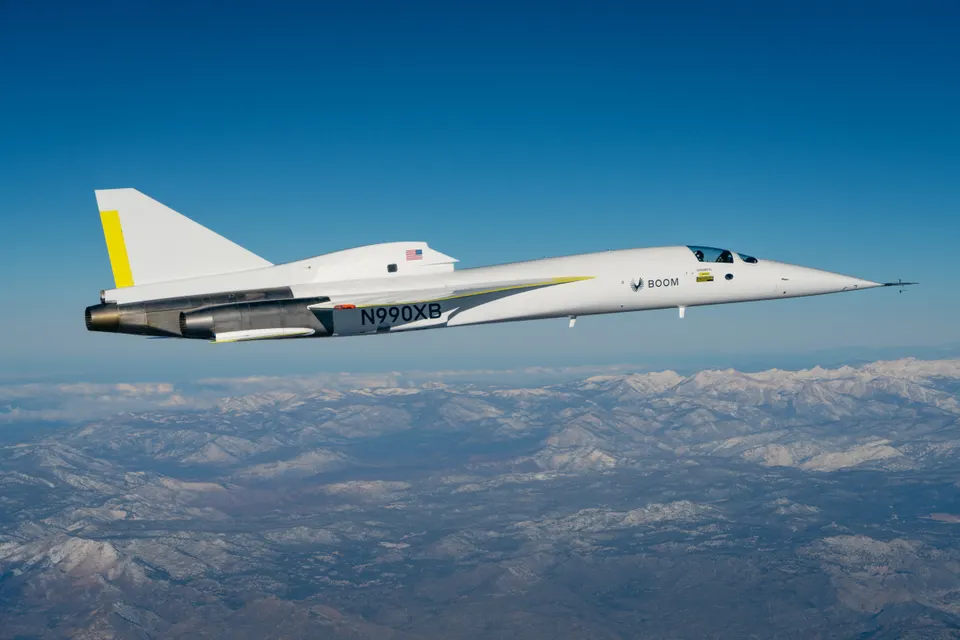
Airframe
Light carbon-fibre body
A carbon-fibre body keeps weight down and handles the mild heating at Mach 1.7.
Propulsion
No afterburners
Its Symphony engines reach supersonic cruise without afterburners, which spray extra fuel into the exhaust; that saves fuel and cuts noise versus Concorde.
Operations
Across oceans
Aimed at routes like New York–London, in about half today's flight time.
Spec sheet
| Spec | Overture |
|---|---|
| Cruise speed | Mach 1.7 over waterR (reported) |
| Passengers | 64–80R (reported) |
| Engines | 4 × SymphonyR (reported) |
| Range | ~4,250 nmiR (reported) |
| Orders and pre-orders | ~130R (reported) |
| XB-1 top speed | Mach 1.122R (reported) |
R reported by the company
Papers & demos
- Jun 2025blogBoomless Cruise (opens boomsupersonic.com)Showed how bending the boom upward lets planes fly supersonic over land with no boom heard below.
- 28 Jan 2025demoXB-1 first supersonic flight (opens boomsupersonic.com)First supersonic passenger-type jet built by an independent company, proving its carbon-fibre body and digital design.
Update log
Fri 6 Jun 2025
- Major: RegulatorRegulatory
Tue 28 Jan 2025
- Major: BlogTest
Tue 23 Jul 2024
- Minor: PressHardware
Fri 22 Mar 2024
- Minor: PressTest
Tue 13 Dec 2022
- Major: PressHardware
Tue 16 Aug 2022
- Minor: PressCommercial
About Boom Supersonic
Boom Supersonic
Overture supersonic airliner, own engine
Boom is building Overture, an airliner that flies at 1.7x the speed of sound, and its own engine, Symphony. Its XB-1 test jet broke the sound barrier in Jan 2025. It now also sells gas turbines based on Symphony to power AI data centers.
- XB-1 went supersonic on 28 January 2025 over the Mojave Desert.
- Overture has about 130 orders and pre-orders, including United, American and Japan Airlines.
- In Dec 2025 launched Superpower, a 42 MW turbine for data centers, with an order for 29 from Crusoe and $300M of new funding.
boomsupersonic.com (opens boomsupersonic.com)Company profile →
- Founded
- 201412 yrs
- Headquarters
- United States
- Status
- Private
- Valuation
- private
- Raised
- $300M1 round
- Last round
- Series B · $300M9 Dec 2025
- Coverage
- 1 program · 7 updateslatest 9 Dec 2025checked 25 Sep
- Lead investors
- Darsana Capital
- Investors
- Japan Airlines (opens jal.com)
- People
- Blake Scholl (opens en.wikipedia.org)Founder and CEO