Apr 2025Element gen2 deployed in Bowles cotton fields (next)
2026Full-season Element gen2 deployments and customer expansion
2027Expansion into additional crop types and regions
Current obstacles
Scaling production while maintaining cost competitivenessManufacturing costs at scale must reach price points farmers can recover through labor savings and yield protection.
Adapting to crop and regional diversityRow spacing, soil conditions, and weather vary by crop and geography; the robot must handle this variability reliably.
Physics limits
Solar power limits duty cycleDaily operation is capped by sunlight hours and seasonal variation. Winter or cloudy climates reduce coverage potential compared to fuel-powered machines.
Mechanical strikes require clear targetThe stereo vision system must see the weed clearly to strike it. Dense crop canopy or mixed weed-crop height situations reduce effectiveness.
Battery energy density limits enduranceBattery storage technology limits the system's nighttime or low-light operation, so scheduling must work within daylight windows.
How it works
3 parts
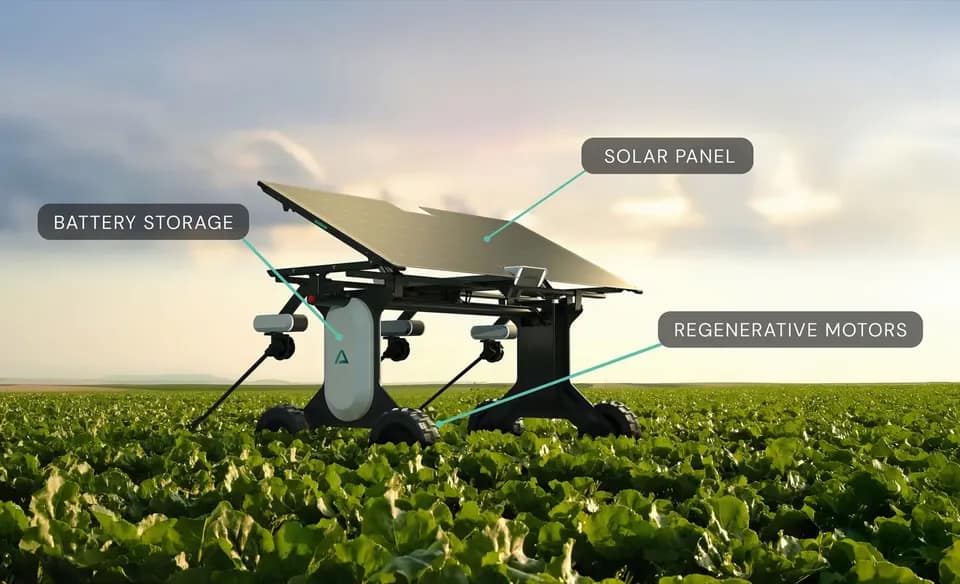
Solar power
All-day operation without charging
Solar panels and battery power the robot dawn to dusk, eliminating refueling and charging downtime.
Vision system
Stereo depth AI identifies weeds in real time
Onboard AI analyzes stereo camera feeds to distinguish crop from weed, adapting to spacing and growth stage.
Mechanical elimination
Targeted strikes without chemicals
Robot uses mechanical force to target weed roots with precision, leaving no residue and avoiding resistance.
Element solar weeding robot, autonomous agriculture
Aigen develops fully autonomous, solar-powered robots for mechanical weed control. The Element robot uses AI and stereo vision to detect and eliminate weeds without herbicides, operating all day from solar power alone. The company is headquartered in Redmond, Washington.
Element has logged over 10,000 operational hours in field trials across multiple crop types.
The Element gen2 delivers 50% more solar power, four times faster AI computing, and compatibility with cotton, soy, and sugar beet.
Available for 2026 delivery at $50,000 per unit; Bowles Farming Company deployed the gen2 in cotton fields during the 2025 season.