
Milestones
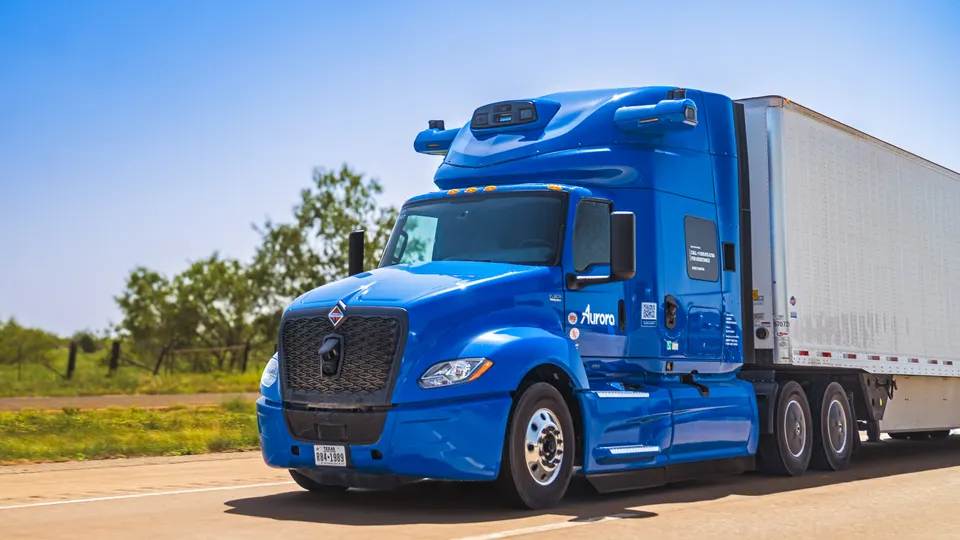
- Driverless commercial launch Dallas–Houston1 May 2025+5 mo
originally Dec 2024Complete. - Fort Worth–El Paso driverless laneOct 2025Complete.
- Phoenix and Laredo lanes added2026Complete.
- Next-gen hardware on International LT without observer22 Jul 2026+3 mo
originally Q2 2026Complete. - About 200 driverless trucks in operationTarget Dec 2026Current milestone.
Most important updates
- 17d ago
- 22 Jul 2026
- 6 May 2026
- 28 Oct 2025
- 1 May 2025
Upcoming
- Oct 2026Roush targets building 20 Aurora trucks a week (next)
- Dec 2026About 200 driverless trucks in operation
- 2027Hirschbach begins taking delivery of 500 Aurora-driven trucks
Current obstacles
- Observer in the cabFrom mid-2025 an observer rode along at a truck maker's request; second-gen trucks on International LT dropped it in July 2026.
- Regulatory patchworkDriverless trucks are allowed in Texas and several Sun Belt states, but not everywhere freight goes.
Physics limits
- Heavy trucks need long stopping distancesA loaded 80,000-lb truck at 65 mph needs about 160 m (525 ft) to stop, including reaction time. Sensors must spot small hazards well beyond that, where lidar returns are sparse.
- Mass multiplies crash energyKinetic energy grows with mass and the square of speed: a loaded truck carries ~18x the energy of a car at the same speed, and hard swerves risk jackknifing or rollover.
- Rain, fog and snow blind sensorsWater droplets scatter the infrared light lidar uses and blur cameras, so sensing range shrinks exactly when stopping distances grow. Radar sees through but only in coarse detail.
How it works
Terminals
Hub-to-hub
Trucks run between Aurora terminals next to highways; human drivers handle the first and last mile if needed.
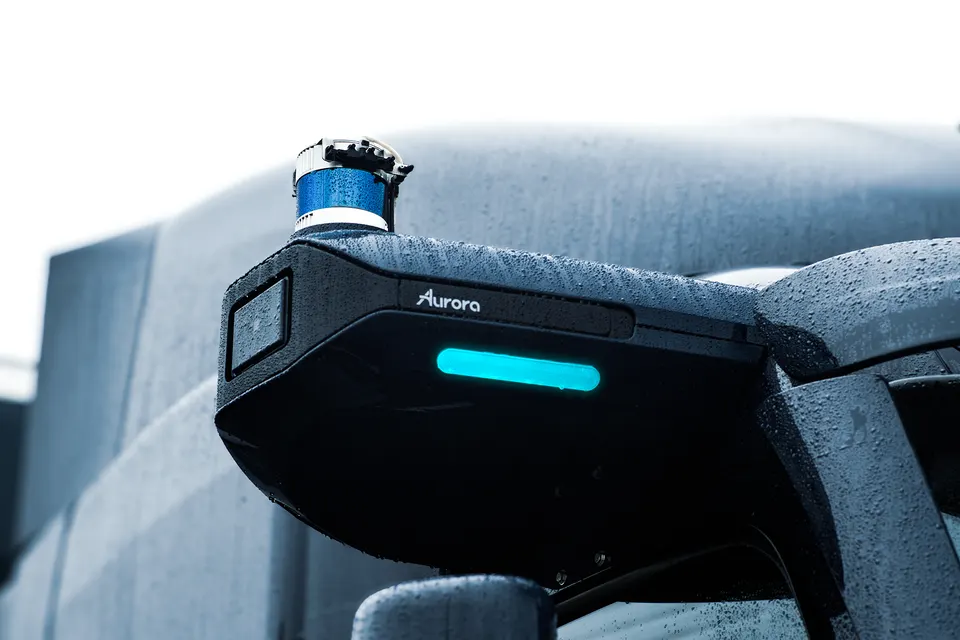
Long-range sensing
Seeing far enough to stop
A loaded truck needs hundreds of metres to stop, so long-range lidar and radar are key for highway driving.
Operations
Remote support
A control centre watches the trucks and gives guidance in odd situations like road closures or inspections.
Spec sheet
| Spec | Aurora Driver for trucks |
|---|---|
| Fleet | ~30 trucks (2026)R (reported) |
| Gross weight class | Class 8 (up to 80,000 lb)R (reported) |
| Primary lidar | FMCW (FirstLight)R (reported) |
| Longest driverless lane | Fort Worth–Phoenix (~1,000 mi)R (reported) |
R reported by the company
Papers & demos
- Dec 2024blogAurora safety case for driverless operationsLaid out the argument and evidence Aurora uses to decide its trucks are safe to run without a driver.
Update log
Wed 23 Sep
- Major: PressCommercial
Wed 22 Jul
- Major: PressHardware
Wed 6 May
- Minor: PressCommercial
Tue 28 Oct 2025
- Minor: PressCommercial
Thu 1 May 2025
- Major: PressCommercial
Mon 20 May 2024
- Minor: PressHardware
About Aurora Innovation
Aurora Innovation
Driverless trucks, Aurora Driver, FMCW lidar
Aurora makes the Aurora Driver for big trucks. In May 2025 it became the first to run paid driverless heavy trucks on US highways, Dallas to Houston. It now runs several Texas and Southwest routes and plans hundreds of trucks on new hardware.
- Launched paid driverless freight between Dallas and Houston on 1 May 2025.
- Runs driverless routes including Fort Worth–El Paso, El Paso–Phoenix and Dallas–Laredo, with about 30 trucks.
- Next-gen hardware on International LT trucks is due to run driverless with no observer from Q2 2026.
- Founded
- 20179 yrs
- Headquarters
- United States
- Status
- Public
- Listed
- AUR (opens google.com)NASDAQ
- Valuation
- public
- Works in
- VehiclesSelf-driving trucks
- Coverage
- 1 program · 6 updateslatest 17d agochecked 25 Sep
- Partners
- PACCAR (opens paccar.com)Volvo Autonomous Solutions (opens volvoautonomoussolutions.com)International (opens international.com)
- Suppliers
- Continental (opens continental.com)
- People
- Chris Urmson (opens en.wikipedia.org)Co-founder and CEODrew BagnellCo-founder and Chief Scientist