

Milestones
- BlueWalker 3 test satellite launched10 Sep 2022Complete.
- First five Block 1 BlueBirds launched on Falcon 912 Sep 2024Complete.
- BlueBird 6, first of the bigger satellites, launched on India's LVM3Dec 2025Complete.
- BlueBird 7 lost when New Glenn's upper stage failed19 Apr 2026Complete.
- BlueBirds 8–10 launched on Falcon 917 Jun 2026Complete.
- BlueBirds 11–13 launched on Falcon 95 Aug 2026Complete.
- About 45 satellites in orbitTarget Dec 2026Current milestone.
Most important updates
- 5 Aug 2026
- 19 Apr 2026
- Dec 2025
- 12 Sep 2024
- 25 Apr 2023
Upcoming
- Dec 2026About 45 satellites in orbitin about 7 weeks (next)
Current obstacles
- Capacity per satelliteEach satellite can only serve so many users, so dozens are needed before service is good enough for everyone.
- Deployment paceReaching about 45 satellites needs several launches a month in late 2026.
Physics limits
- A phone's weak signal forces enormous antennasA phone transmits about 0.2 W through a tiny antenna, and the signal spreads over 500+ km. Catching it takes arrays of tens to hundreds of square metres; Block 2 BlueBirds are about 220 m².
- Capacity is capped by the carriers' spectrumSatellites reuse the partner carriers' mobile bands, often only a few MHz wide. Each beam covers a wide area, so all phones in it share that thin slice of bandwidth.
- Fast satellites shift the signal's frequencyAt about 7.5 km/s the Doppler effect moves the frequency the phone hears, and timing drifts. The satellite must pre-correct every beam so standard phones, built for still towers, can lock on.
How it works
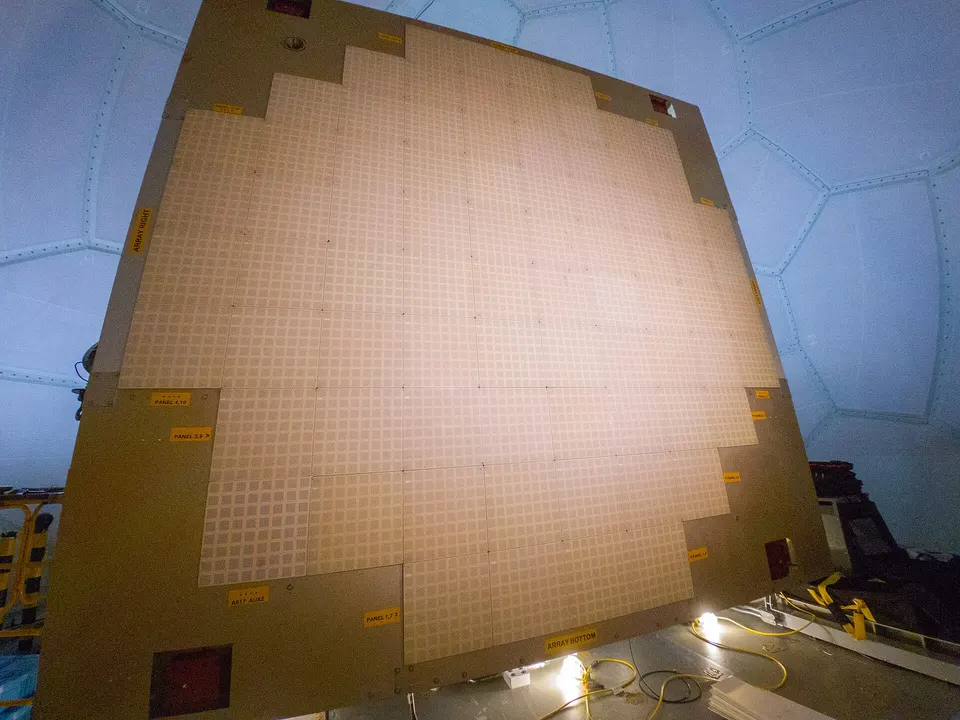
Unfold
Folded arrays open in orbit
Each satellite launches folded and opens into a big flat panel of tiles, each with antennas, amplifiers and solar cells.
Beams
Aiming many beams
Signals from thousands of tiles are timed so they add up in chosen directions, forming narrow beams that each cover an area like a cell tower.
Backhaul
Down to the carriers
Traffic goes to ground stations wired into the phone companies' networks, so your phone just sees its own carrier.
Spec sheet
| Spec | BlueBird constellation | BlueBird Block 1 | Change |
|---|---|---|---|
| Array area (Block 2) | ~2,400 sq ft (~223 m²)R (reported) | ~693 sq ft (Block 1) | —no comparable change |
| Peak download (Block 1, tested) | 98.9 MbpsR (reported) | — | —no comparable change |
| Satellites in orbit | 13 (Aug 2026)R (reported) | — | —no comparable change |
| 2026 year-end target | ~45 satellitesR (reported) | — | —no comparable change |
| Orbit | Low Earth orbit (~500 km class)E (estimated) | — | —no comparable change |
R reported by the company · E our estimate
Papers & demos
- 25 Apr 2023demoFirst space-based voice call to an unmodified smartphone via BlueWalker 3 (opens ast-science.com)Proved a normal phone can talk to a satellite if the satellite's antenna is big enough.
Update log
Wed 5 Aug
- Minor: PressHardware
Wed 17 Jun
- Minor: PressHardware
Sun 19 Apr
- Major: PressHardware
Dec 2025
- Major: PressHardware
Thu 12 Sep 2024
- Major: PressHardware
Tue 25 Apr 2023
- Major: PressTest
About AST SpaceMobile
AST SpaceMobile
Satellites that talk to normal phones
AST SpaceMobile builds huge satellites (BlueBirds) that act like cell towers in space, connecting normal phones through mobile carriers. It had 13 in orbit by Aug 2026 and aims for about 45 by end of 2026.
- Made the first call from space to a normal phone (2023) with its BlueWalker 3 test satellite.
- Newer BlueBirds unfold to about 2,400 sq ft, the largest commercial antennas in low orbit.
- Lost BlueBird 7 to a New Glenn upper-stage anomaly in April 2026, then launched six more on Falcon 9.
- Founded
- 20179 yrs
- Headquarters
- United States
- Status
- Public
- Listed
- ASTS (opens google.com)NASDAQ
- Valuation
- public
- Raised
- $207M1 round
- Last round
- Strategic investment · $207MJan 2024
- Works in
- SpaceflightSatellites
- Coverage
- 1 program · 6 updateslatest 5 Aug 2026checked 25 Sep
- Lead investors
- AT&TGoogleVodafone
- Suppliers
- SpaceXBlue Origin
- People
- Abel AvellanFounder, Chairman and CEO