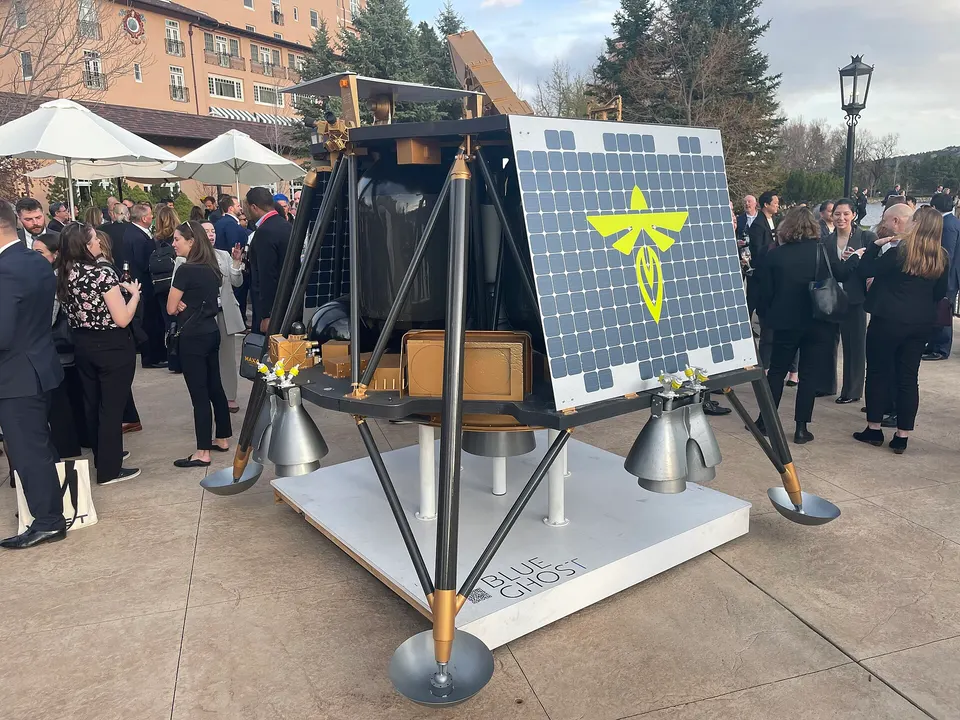

Milestones
- NASA picks Blue Ghost for a Moon deliveryFeb 2021Complete.
- Mission 1 launches on Falcon 915 Jan 2025Complete.
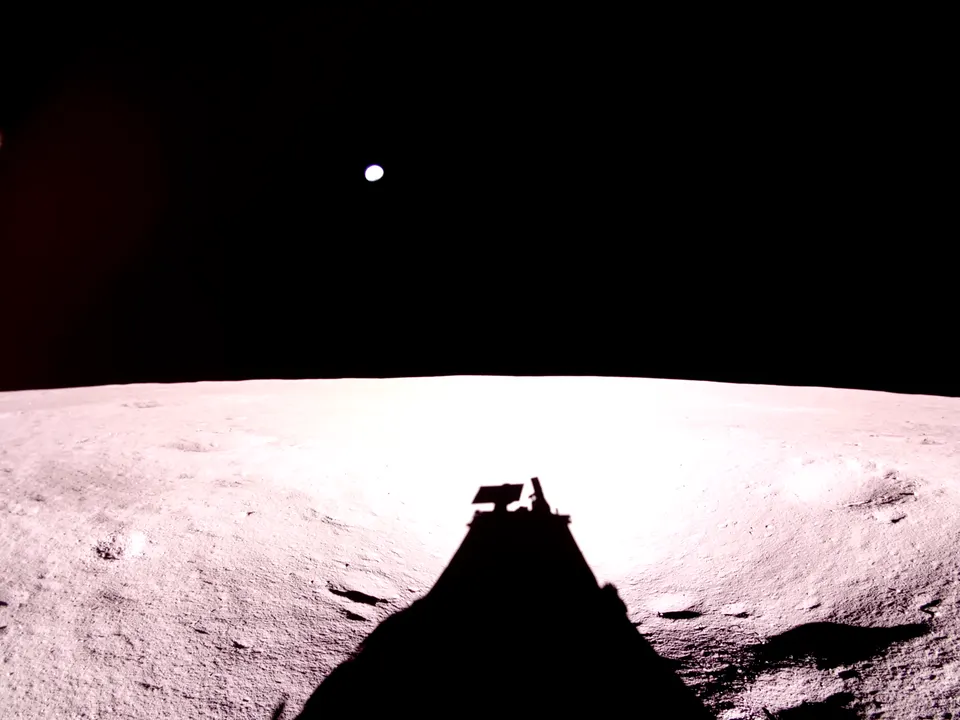
- Mission 1 lands upright on the Moon2 Mar 2025Complete.
- Mission 1 films sunset on the Moon and ends16 Mar 2025Complete.
- Mission 2 far-side landingTarget 2027+12 mo
originally 2026Current milestone.
Most important updates
- 19 Aug 2026
- Oct 2025
- 14 Mar 2025
- 2 Mar 2025
- 20 May 2021
Upcoming
- 2027Mission 2 far-side landing+12 mo
originally 2026(next)
Current obstacles
- Surviving the lunar nightWithout a heat source, landers die at nightfall; longer missions need heaters or big batteries.
- Landing on rougher terrainFar-side and polar sites are steeper and darker, so the lander is more likely to tip over.
Physics limits
- Solar landers die in the lunar nightA lunar night lasts about 14 Earth days at around −170 °C. Batteries to keep electronics warm that long would outweigh the lander, so without nuclear heat, missions end at sunset.
- No air: landing is all rocket brakingThe lander must cancel about 1.7 km/s of orbital speed with its engines alone, guided by cameras and radar. Every kilogram of payload needs extra fuel, and there is no second try.
- The far side can't see EarthThe Moon blocks radio to Earth on its far side, so a far-side lander needs a relay satellite in lunar orbit. That is the reason Mission 2 flies its own relay.
How it works
Cruise
A slow, fuel-saving trip
Blue Ghost spent about 45 days looping around Earth and the Moon to save fuel instead of flying straight there.
Descent
Landing by sight
Cameras and a laser measure the ground as it descends, steering it away from rocks and craters.
Surface
Runs on sunlight for one lunar day
It works on solar power for one lunar day (about 14 Earth days), then freezes in the two-week night.
Spec sheet
| Spec | Blue Ghost |
|---|---|
| Height | ~2 mR (reported) |
| Width | ~3.5 mR (reported) |
| Payload capacity | ~150 kgR (reported) |
| Mission 1 NASA payloads | 10R (reported) |
| Mission 1 surface ops | ~14 daysR (reported) |
R reported by the company
Papers & demos
- 2 Mar 2025demoBlue Ghost Mission 1 landing in Mare Crisium (opens fireflyspace.com)First fully successful private soft landing on the Moon; ran 10 NASA instruments for about 14 days.
Update log
Wed 19 Aug
- Minor: PressPartnership
Oct 2025
- Minor: RegulatorTest
Fri 14 Mar 2025
- Minor: RegulatorResearch
Sun 2 Mar 2025
- Major: LivestreamTest
Thu 20 May 2021
- Minor: PressCommercial
About Firefly Aerospace
Firefly Aerospace
Blue Ghost Moon lander, Alpha rocket
Firefly builds the Alpha small rocket, the Blue Ghost Moon lander and, with Northrop Grumman, the Eclipse rocket. Blue Ghost made the first fully successful private Moon landing in March 2025. Listed on Nasdaq in Aug 2025.
- Blue Ghost landed upright on 2 March 2025 and ran NASA experiments for a full lunar day.
- Alpha failed in flight (Apr 2025) and exploded in a ground test (Sep 2025) before flying again in March 2026.
- Blue Ghost Mission 2 to the lunar far side is targeted for late 2026.
- Founded
- 20179 yrs
- Headquarters
- United States
- Status
- Public
- Listed
- FLY (opens google.com)NASDAQ
- Valuation
- public
- Last round
- IPO (Nasdaq) · $868M7 Aug 2025
- Works in
- SpaceflightMoon & deep space
- Coverage
- 3 programs · 15 updateslatest 9 Sep 2026checked 25 Sep
- Customers
- NASA (opens nasa.gov)
- People
- Jason Kim (opens fireflyspace.com)CEO