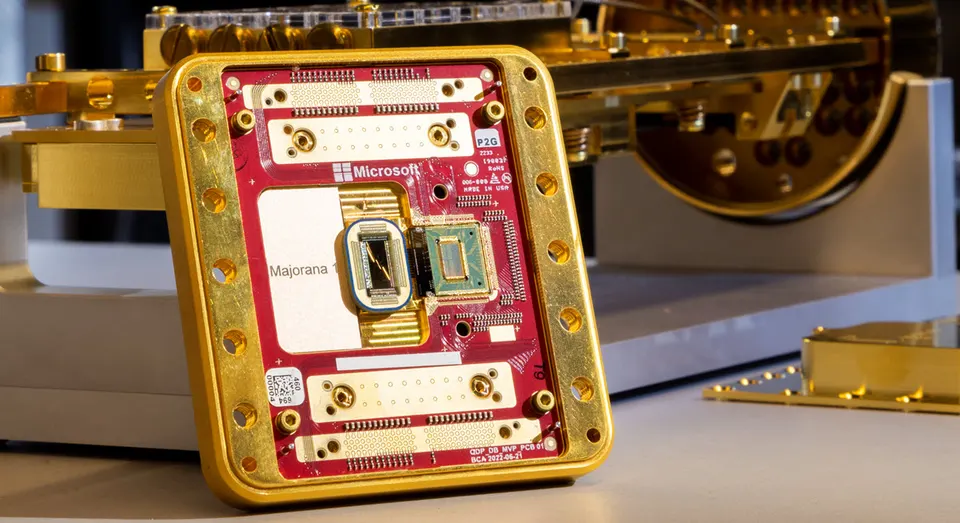

Milestones
- Station Q founded2005Complete.
- 2018 Nature Majorana paper retractedMar 2021Complete.
- Topological gap protocol resultsJun 2023Complete.
- Majorana 1 and Nature parity measurement paper19 Feb 2025Complete.
- Majorana 2 presented at BuildJun 2026Complete.
- Fault-tolerant prototypeTarget 2029Not yet reached.
Most important updates
- 2 Jun 2026
- Mar 2025
- 19 Feb 2025
- 6 Feb 2025
Upcoming
- 2029Fault-tolerant prototype (next)
Current obstacles
- Proof of topological protectionCritics say the data can't yet tell real Majorana states from ordinary ones. Full qubit operations still need to be shown.
Physics limits
- Protection needs near-perfect materialsTopological protection holds only if the superconducting gap is large and disorder tiny. Small impurities in the wires create ordinary states that mimic Majorana signatures, which is why results are debated.
- Majoranas alone can't do every gateMeasuring and braiding Majoranas yields only a restricted set of operations. Universal computing needs extra 'magic states', made with conventional, error-prone methods and then purified.
- Stray electrons flip the qubitA single unpaired electron entering the wire flips its parity, the stored value. Such events must be very rare; Microsoft has reported parity lifetimes of around a millisecond.
How it works
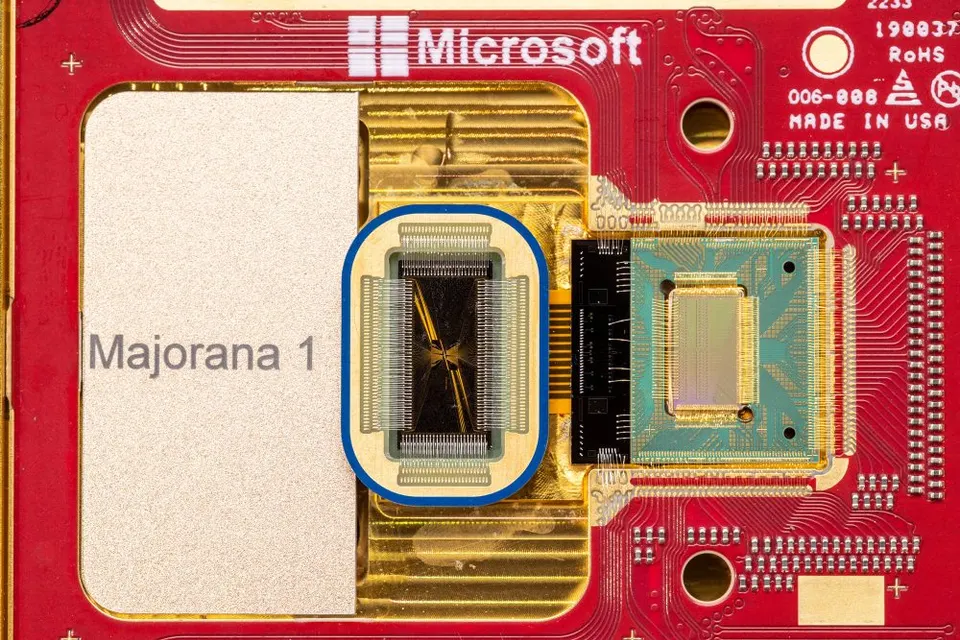
Topoconductor nanowires
An indium arsenide wire coated with aluminium becomes superconducting near absolute zero; in a magnetic field, Majorana states should form at its ends.
Tetron
Two wires joined in an H shape hold four Majoranas. The qubit is whether the number of electrons is even or odd, spread across the wires.
Quantum-dot sensor
A nearby quantum dot's capacitance changes with that parity, which microwave reflection reads in about a microsecond.
Digital, by measurement
Operations are done by switching measurements on and off with voltage pulses, instead of finely shaped analog pulses.
Update log
Tue 2 Jun
- Minor: BlogHardware
Mar 2025
- Minor: PressResearch
Wed 19 Feb 2025
- Major: BlogHardware
Thu 6 Feb 2025
- Minor: RegulatorOther
About Microsoft Quantum
Microsoft Quantum
Topological qubits, Majorana chips, Azure Quantum
Microsoft is betting on topological qubits built from Majorana states in tiny superconducting wires, which in theory resist noise. It unveiled Majorana 1 in February 2025, a claim many physicists see as unproven. It also works with Quantinuum and Atom Computing.
- Majorana 1 (Feb 2025) is billed as an 8-qubit topological chip. Outside experts dispute that topological qubits were shown.
- Presented Majorana 2 at Build in June 2026, reporting much longer qubit lifetimes.
- In the final phase of DARPA's US2QC programme.
quantum.microsoft.com (opens quantum.microsoft.com)Company profile →
- Founded
- 200521 yrs
- Headquarters
- United States
- Status
- Subsidiaryof Microsoft
- Valuation
- Microsoft-owned
- Works in
- QuantumTopological
- Coverage
- 1 program · 5 updateslatest 2 Jun 2026checked 25 Sep
- Customers
- DARPA (opens darpa.mil)
- Partners
- QuantinuumAtom Computing
- People
- Chetan Nayak (opens en.wikipedia.org)Technical Fellow, quantum hardware