
Milestones
- Honeywell System Model H1 launched2020Complete.
- H2 launched with 32 qubits9 May 2023Complete.
- First 99.9% two-qubit gate fidelityApr 2024Complete.
- H2 upgraded to 56 qubitsJun 2024Complete.
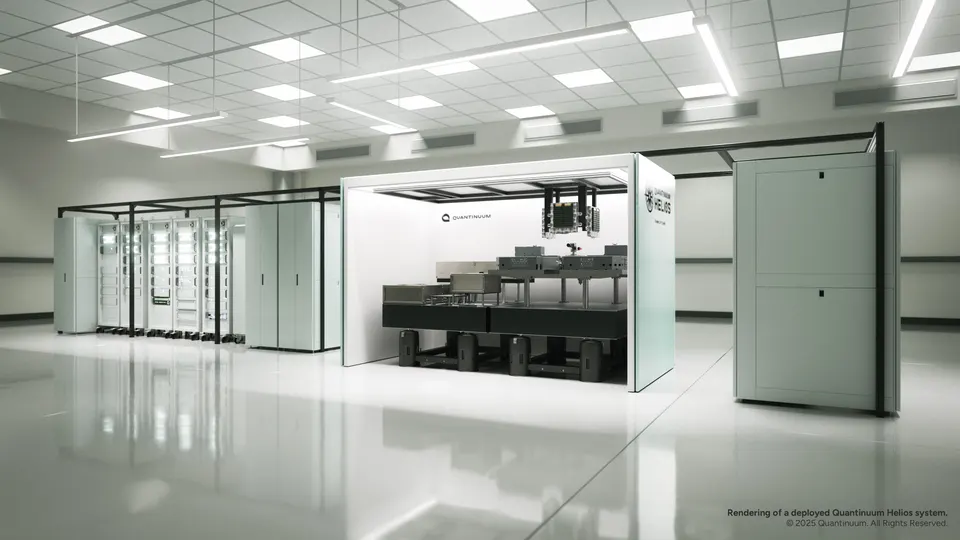
- Helios launched (98 qubits)5 Nov 2025Complete.
- Sol (192 qubits)Target 2027Not yet reached.
- Apollo universal fault-tolerant systemTarget 2029Not yet reached.
Most important updates
- 8 Sep 2026
- 13 Aug 2026
- 11 Aug 2026
- 5 Nov 2025
- 3 Apr 2024
Upcoming
- 2027Sol (192 qubits) (next)
- 2029Apollo universal fault-tolerant system
Current obstacles
- Transport time and heatingMoving and re-cooling ions takes most of the run time and adds errors. Faster, cleaner moves allow longer programs.
- Optics for hundreds of ionsAiming stable laser light at many zones needs optics built into the trap itself.
Physics limits
- Ions are slowIon gates take tens to hundreds of microseconds, and moving ions takes longer, roughly a thousand times slower than superconducting gates. Deep error-corrected algorithms could take days.
- Laser optics grow with every ionEach gate needs precisely aimed, stable laser light. Delivering it to hundreds of ions without stray light reaching neighbours needs complex optics that get harder with every qubit added.
- Electrode noise heats ionsMoving ions shakes them, and electric-field noise from nearby electrode surfaces heats them further. That noise rises steeply (about 1/distance⁴) as traps shrink, which fights miniaturisation.
How it works
Trap
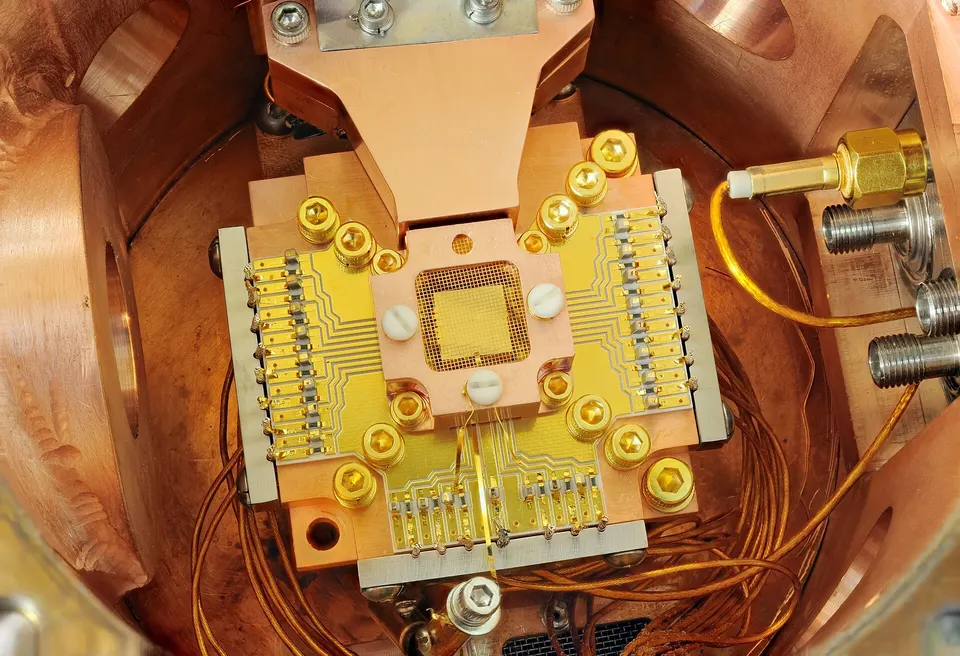
Ions held by electric fields
Charged barium atoms float above a chip, held by electric fields in a cold, ultra-high vacuum.
Qubit
Two energy levels
Each qubit is two energy levels of one ion. They are identical across all ions and very long-lived.
Gates
Laser-driven entanglement
Two ions are moved into a gate zone, where lasers link their states through their shared wobble.
Routing
Junction-based sorting
A ring-and-junction trap lets ions be rotated and sorted, so any pair can meet quickly.
Spec sheet
| Spec | Helios | H2 (56 qubits) | Change |
|---|---|---|---|
| Physical qubits | 98R (reported) | 56 (H2) | —no comparable change |
| Qubit ion | Barium-137R (reported) | Ytterbium-171 | —no comparable change |
| Two-qubit gate fidelity | 99.921%R (reported) | — | —no comparable change |
| Single-qubit gate fidelity | 99.9975%R (reported) | — | —no comparable change |
| Error-corrected logical qubits | 48R (reported) | — | —no comparable change |
| Error-detected logical qubits | 94R (reported) | — | —no comparable change |
| Connectivity | All-to-all (via ion transport)R (reported) | — | —no comparable change |
R reported by the company
Papers & demos
- Mar 2025paperCertified randomness using a trapped-ion quantum processor (opens nature.com)With JPMorgan, made randomness certified by supercomputers, a first practical use claim.
- Apr 2024paperDemonstration of logical qubits with Microsoft (H2) (opens arxiv.org)Four logical qubits with error rates up to 800 times below physical rates.
Update log
Tue 8 Sep
- Minor: PressFunding
Thu 13 Aug
- Minor: PressManufacturing
Tue 11 Aug
- Minor: PressPartnership
Wed 5 Nov 2025
- Major: PressHardware
Wed 3 Apr 2024
- Major: BlogResearch
Tue 9 May 2023
- Minor: PressHardware
About Quantinuum
Quantinuum
Trapped-ion computers, Helios, H2
Formed in 2021 by merging Honeywell Quantum Solutions and Cambridge Quantum. Its trapped-ion computers hold gate-accuracy records. It launched 98-qubit Helios in November 2025 and listed on Nasdaq in June 2026. Honeywell remains majority owner.
- IPO on 4 June 2026 raised $1.68B at $60 a share. Honeywell and Cambridge Quantum holders kept about 82%.
- Helios (Nov 2025): 98 barium qubits with 99.921% two-qubit fidelity.
- Roadmap: Sol (192 qubits) in 2027, fault-tolerant Apollo in 2029.
- Founded
- 20215 yrs
- Headquarters
- United StatesUnited Kingdom
- Status
- Publicof Honeywell
- Listed
- QNT (opens google.com)NASDAQ
- Valuation
- $13Bmarket capSep 2026
- Raised
- $900M2 rounds
- Last round
- IPO · $1.7BJun 2026
- Works in
- QuantumTrapped ion
- Coverage
- 1 program · 10 updateslatest 8 Sep 2026checked 25 Sep
- Lead investors
- Quanta ComputerNVenturesQED InvestorsJPMorgan Chase
- Investors
- Honeywell (opens honeywell.com)
- People
- Rajeev HazraPresident and CEO