
Milestones
- Applied for EU approvalJun 2025Complete.
- Main trial results in NEJMOct 2025Complete.
- EU approval and launchJul 2026Complete.
- First paid implants; insurers start covering itNowCurrent milestone.
- Apply for FDA approvalNot yet reached.
Most important updates
- 22 Jul 2026
- 22 Jul 2026
- 5 Mar 2026
- 20 Oct 2025
- 21 Oct 2024
Current obstacles
- Who pays?Each device may cost hundreds of thousands of dollars; each country must agree to pay for it.
- US approvalFDA review isn't done; US availability depends on it.
Physics limits
- Pixel size caps sharpnessEach pixel is 100 µm wide, which limits vision to about 20/420 without zoom. Smaller pixels make too little current to reliably trigger retinal cells.
- It needs the inner retina to surviveThe chip drives the retina's bipolar cells, which outlive the dead light-sensing cells. In diseases where those inner cells are also lost, there is nothing left to stimulate.
- Light safety limits the signalEye-safety rules cap how much infrared light can be beamed onto the retina, which limits the current each pixel can make and so the contrast and brightness of the image.
How it works
1. Capture
Camera sees the scene
A camera on the glasses films the scene, and a small computer sharpens and zooms it.
2. Project
Beam it in as infrared
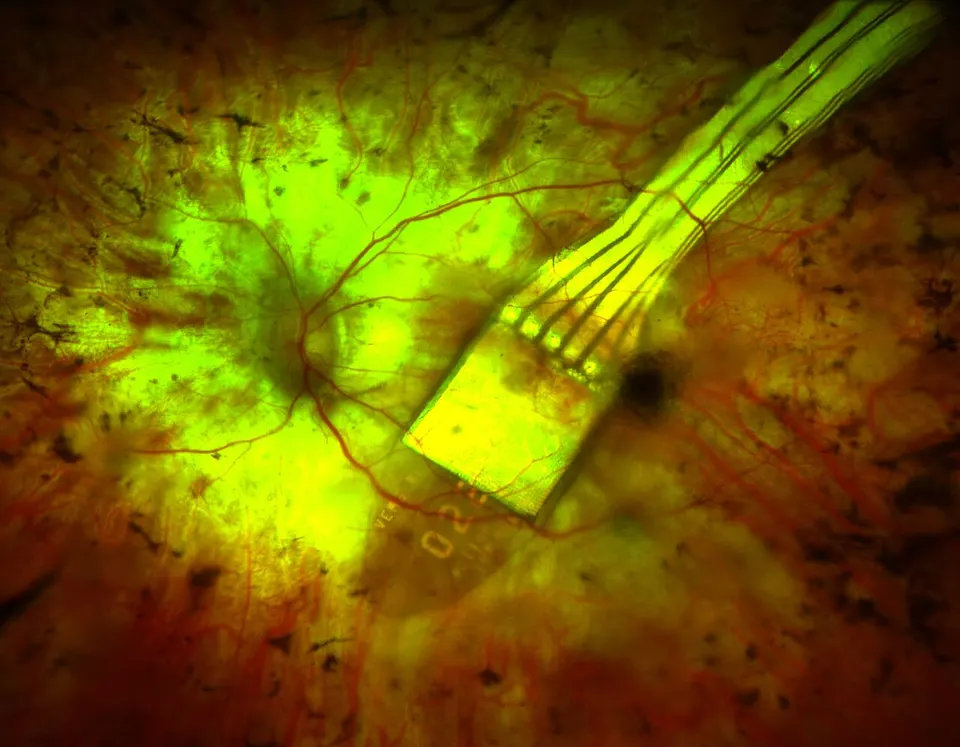
A projector beams the image as flashes of infrared light onto the chip under the retina.
3. Stimulate
Chip wakes the retina
Each pixel turns light into current that stimulates surviving retina cells, which pass the signal to the brain.
Spec sheet
| Spec | PRIMA retinal implant |
|---|---|
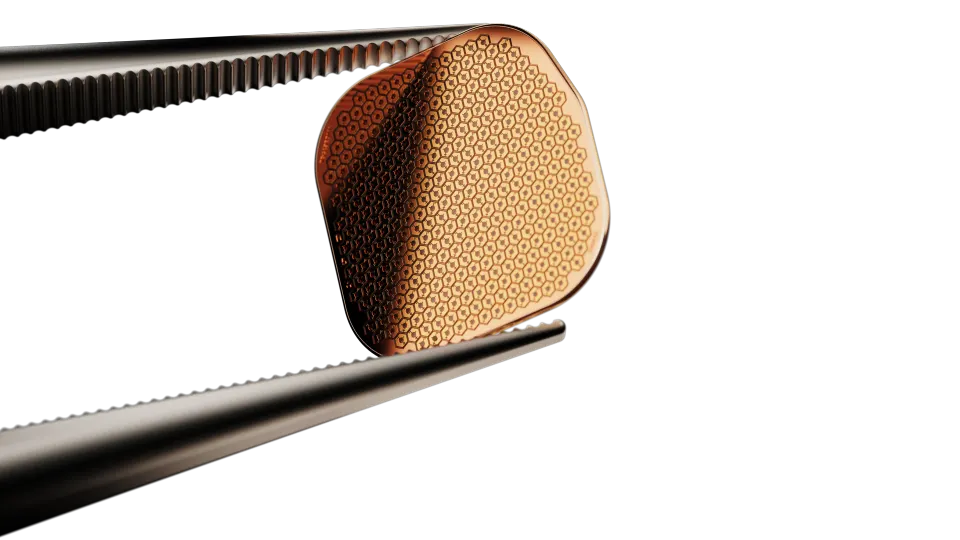
| Chip size | 2 x 2 mmR (reported) |
| Thickness | 30 µmR (reported) |
| Pixels | 378R (reported) |
| Pixel size | 100 µmR (reported) |
| Power | Near-infrared light, photovoltaicR (reported) |
| Meaningful acuity gain (12 mo) | ~80% of evaluated patientsR (reported) |
R reported by the company
Papers & demos
- Oct 2025paperSubretinal photovoltaic implant to restore vision in geographic atrophy due to AMD (NEJM) (opens doi.org)Main trial results behind its regulatory filings.
Update log
Wed 22 Jul
- Major: PressRegulatory
- Major: PressRegulatory
Thu 5 Mar
- Major: PressFunding
Wed 14 Jan
- Minor: PressResearch
Mon 20 Oct 2025
- Major: PaperResearch
Mon 23 Jun 2025
- Minor: BlogRegulatory
Mon 25 Nov 2024
- Minor: PressRegulatory
Mon 21 Oct 2024
- Major: PressTest
Fri 27 Sep 2024
- Minor: BlogOther
About Science Corporation
Science Corporation
PRIMA eye implant, restoring vision
California company founded by Neuralink co-founder Max Hodak. Its PRIMA system puts a 2 mm solar-cell chip under the retina and uses camera glasses to beam images onto it, restoring some central vision in advanced macular degeneration. Approved in the EU in Jul 2026.
- Main trial (NEJM, Oct 2025): about 80% of patients saw meaningfully better after 12 months; many could read letters and words.
- EU approval (CE mark) in Jul 2026 allows sales in 30 European countries; first paid implants expected in Germany.
- Raised $230M in Mar 2026 to launch PRIMA and fund its brain-interface research.
- Founded
- 20215 yrs
- Headquarters
- United States
- Status
- Private
- Valuation
- private
- Raised
- $230M1 round
- Last round
- Series C · $230MMar 2026
- Works in
- NeurotechRestoring sight
- Coverage
- 1 program · 9 updateslatest 22 Jul 2026checked 25 Sep
- Suppliers
- Pixium Vision (opens science.xyz)
- People
- Max Hodak (opens en.wikipedia.org)Founder and CEO