

Milestones
- First human use (temporary)2023Complete.
- 4,096-electrode human recordingMay 2024Complete.
- FDA clearance, up to 30 daysApr 2025Complete.
- 100+ procedures at 18 hospitalsSep 2026Complete.
- Permanent wireless implant trialsNowCurrent milestone.
Most important updates
- 16d ago
- 12 Jan 2026
- 5 Nov 2025
- 2 Oct 2025
- 17 Apr 2025
Current obstacles
- Fully implanted electronicsA permanent system needs sealed, wireless electronics to go with the film.
- Lasting for yearsThe film must stay stable on the moving brain surface for years.
Physics limits
- Surface electrodes hear mostly the top layerElectrical signals fade quickly with distance, so a film on the surface mainly records the outer millimetre or two of cortex and blends neighbouring neurons together.
- Thin films let moisture in over yearsPolymer films thinner than a hair slowly absorb body fluid, which can corrode metal traces and electronics. Sealing them for decades is an unsolved materials problem.
- Heat caps the data rateImplants may warm nearby brain tissue by only about 1 °C. That fixes the power budget for amplifiers and radio, which limits how many channels can be read and sent out wirelessly.
How it works
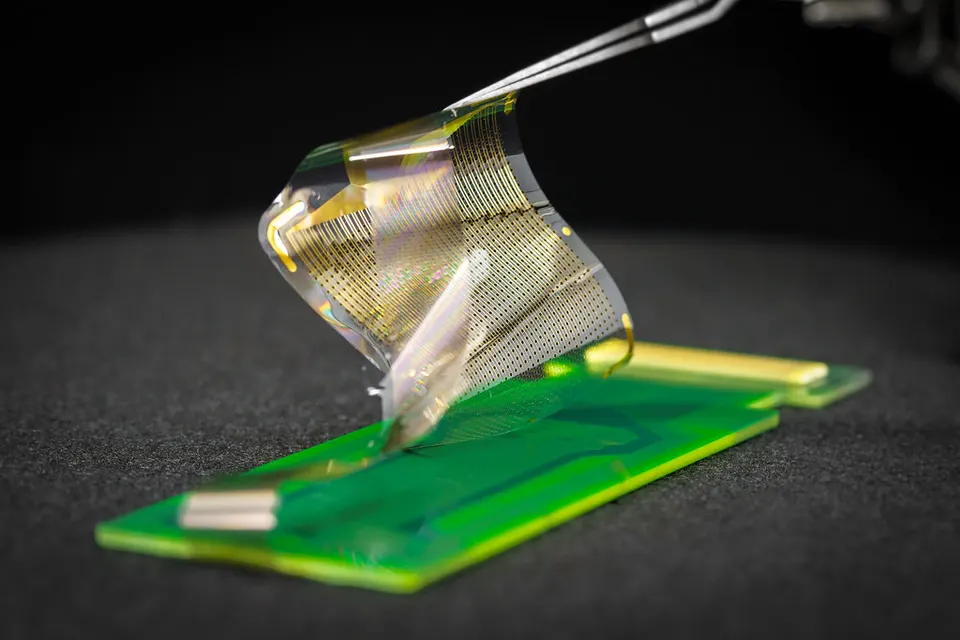
1. Insert
Slide film onto the brain
The film goes through a narrow slit in the skull and unrolls on the brain surface.
2. Record
Record dense signals
1,024 tiny electrodes per piece capture detailed activity from movement or speech areas.
3. Decode
AI reads intent
AI trained on the recordings turns activity patterns into intended movements or speech.
Spec sheet
| Spec | Layer 7 Cortical Interface |
|---|---|
| Electrodes per module | 1,024R (reported) |
| Max recorded at once | 4,096 electrodesR (reported) |
| Tissue penetration | None (surface array)R (reported) |
| FDA-cleared duration | Up to 30 daysR (reported) |
| Insertion | Cranial micro-slitR (reported) |
| Patient procedures | 100+ at 18 institutionsR (reported) |
R reported by the company
Papers & demos
- May 2024demo4,096 electrodes recorded simultaneously on a human brainShowed Layer 7 pieces can scale to thousands of channels during surgery.
Update log
Thu 24 Sep
- Major: PressFunding
Mon 12 Jan
- Major: PressPartnership
Wed 5 Nov 2025
- Minor: PressPartnership
Thu 2 Oct 2025
- Major: PaperResearch
Thu 17 Apr 2025
- Major: PressRegulatory
Mon 16 Dec 2024
- Minor: PressFunding
May 2024
- Minor: PressTest
Fri 22 Mar 2024
- Minor: PressTest
About Precision Neuroscience
Precision Neuroscience
Layer 7 thin-film brain interface
New York company co-founded by neurosurgeon Ben Rapoport (a Neuralink co-founder) and CEO Michael Mager. Layer 7 is a thin film of 1,024 electrodes that sits on the brain without piercing it. In 2025 the FDA cleared it for use up to 30 days.
- Over 100 patient procedures at 18 hospitals, mostly short placements during brain surgery.
- Raised $250M on 24 Sep 2026, co-led by Pershing Square and the Ackman Oxman Institute; $430M raised in total.
- Recorded from 4,096 electrodes on a human brain at once in 2024, a record then.
precisionneuro.io (opens precisionneuro.io)Company profile →
- Founded
- 20215 yrs
- Headquarters
- United States
- Status
- Private
- Valuation
- $1BprivateSep 2026
- Raised
- $352M2 rounds
- Last round
- Series D · $250M24 Sep 2026
- Works in
- NeurotechMinimally invasive BCIs
- Coverage
- 1 program · 8 updateslatest 16d agochecked 25 Sep
- Lead investors
- Pershing SquareAckman Oxman Institute
- Partners
- Medtronic (opens medtronic.com)
- Investors
- Pershing Square
- People
- Michael MagerCo-founder and CEOBen RapoportCo-founder and Chief Science Officer