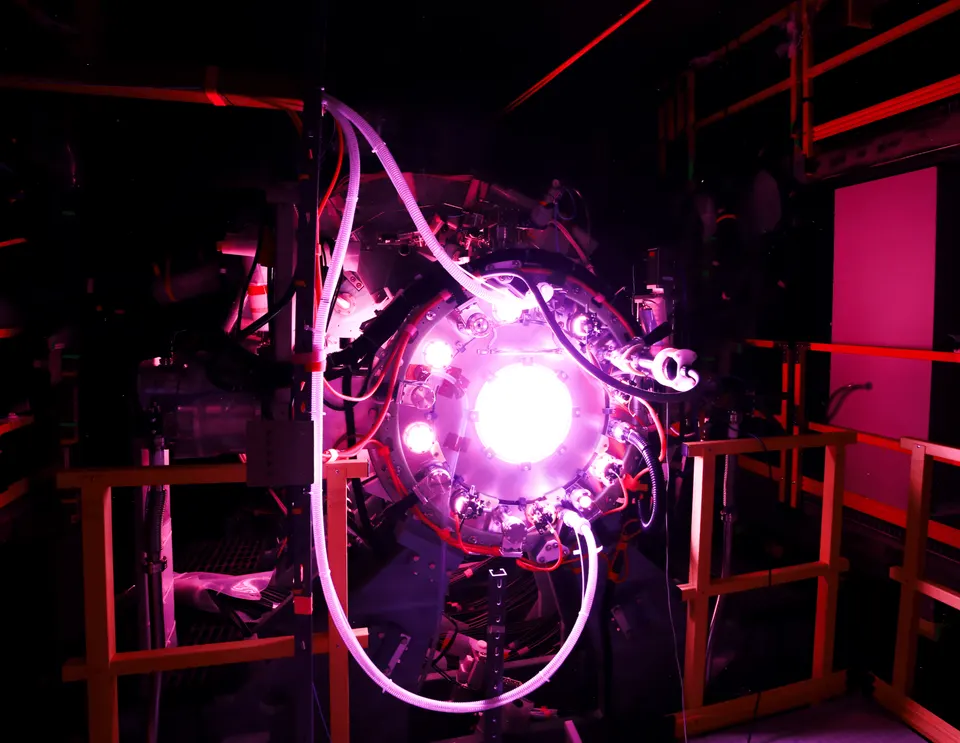

Milestones
- Trenta reaches 9 keV plasma ion temperature2021Complete.
- Polaris construction begins2021Complete.
- Polaris begins operationsJan 2025Complete.
- Measurable D-T fusion and 150 million °C plasmaFeb 2026Complete.
- Demonstrate electricity recovered from fusionNowCurrent milestone.
Most important updates
- 8 Sep 2026
- Feb 2026
- 22 Jun 2021
Upcoming
- 2026Polaris electricity-recovery demonstration results (next)
Current obstacles
- Energy recovery efficiencyNet power needs almost no loss in storing, switching and recovering energy each pulse; small losses add up fast.
- Keeping the plasma stablePlasma rings tend to tip and spin out of shape; they must stay stable while merging and being squeezed.
Physics limits
- D-He3 fuel needs far hotter plasma than D-THelium-3 has twice tritium's charge, so nuclei repel harder. D-He3 reacts best near 60 keV, roughly 700 million °C, several times hotter than D-T, and still fuses more slowly.
- Hot plasma radiates its energy awayFast electrons emit X-rays as they swerve past ions (bremsstrahlung). Losses grow with temperature and fuel charge, so at D-He3 temperatures radiation eats much of the fusion gain.
- Every pulse wears the electronicsEach pulse moves megajoules through capacitors and switches in microseconds. A plant pulsing once a second fires over 30 million times a year, and these parts degrade with every cycle.
How it works

Form
Make two plasma rings
Coils at each end turn gas into plasma rings (FRCs) whose own currents hold them together.
Collide
Fire them at each other
Magnets shoot the rings down the tube; they crash and merge in the middle, turning speed into heat.
Compress
Squeeze to fusion conditions
Magnets squeeze the merged plasma within a millisecond to over 100 million degrees, and atoms fuse.
Recover
Pull electricity back out
The hot plasma expands, pushes on the magnetic field and drives current back into capacitors for the next pulse.
Spec sheet
| Spec | Polaris |
|---|---|
| Plasma temperature reached | 150 million °CR (reported) |
| Ion temperature (Trenta) | 9 keVR (reported) |
| Fuel tested | D-T (target D-He3)R (reported) |
| Prototype generation | 7thR (reported) |
R reported by the company
Papers & demos
- Feb 2026demoPolaris D-T campaign: measurable fusion at 150 million degrees (opens helionenergy.com)First private machine to report measurable D-T fusion, backing Helion's approach at scale.
- 2021demoTrenta prototype reaches 9 keV ion temperature (opens helionenergy.com)Its sixth prototype reached fusion-level temperatures in a privately built FRC machine.
Update log
Tue 8 Sep
- Minor: PressOther
Feb 2026
- Major: PressTest
Tue 22 Jun 2021
- Major: PressTest
About Helion
Helion
Pulsed FRC fusion, Polaris, Orion plant for Microsoft
Washington state company building pulsed fusion machines that smash and squeeze plasma rings (FRCs), then pull electricity straight out with no steam turbine. It plans to power Microsoft from its Orion plant from 2028.
- Polaris, its seventh prototype, reported measurable D-T fusion at 150 million °C in February 2026.
- Building its Orion plant in Malaga, Washington; got state operating licences in June 2026.
- Signed the first fusion power deal (Microsoft, 50 MW from 2028) and a 500 MW plant deal with Nucor.
- Founded
- 201313 yrs
- Headquarters
- United States
- Status
- Private
- Valuation
- $5.4BprivateJan 2025
- Raised
- $925M2 rounds
- Last round
- Series F · $425MJan 2025$5.4B post
- Works in
- EnergyFusion
- Coverage
- 2 programs · 11 updateslatest 8 Sep 2026checked 25 Sep
- Lead investors
- Sam Altman
- Investors
- Sam Altman (opens en.wikipedia.org)
- People
- David Kirtley (opens helionenergy.com)Co-founder & CEO