

Milestones
- Pilot-scale tandem developmentNowCurrent milestone.
Most important updates
- May 2023
Current obstacles
- Perovskite stabilityPerovskites break down with heat, moisture and light; lasting decades outdoors is unproven.
Physics limits
- Perovskites are soft, ionic crystalsTheir ions move under light, heat and electric fields, and water breaks them down, so films degrade in years where silicon lasts decades; this is built into the material.
- Two layers must share one currentIn a two-terminal tandem the weaker cell sets the current. As sunlight's colour shifts through the day, the layers fall out of balance; even ideally, two layers cap near ~45%.
How it works
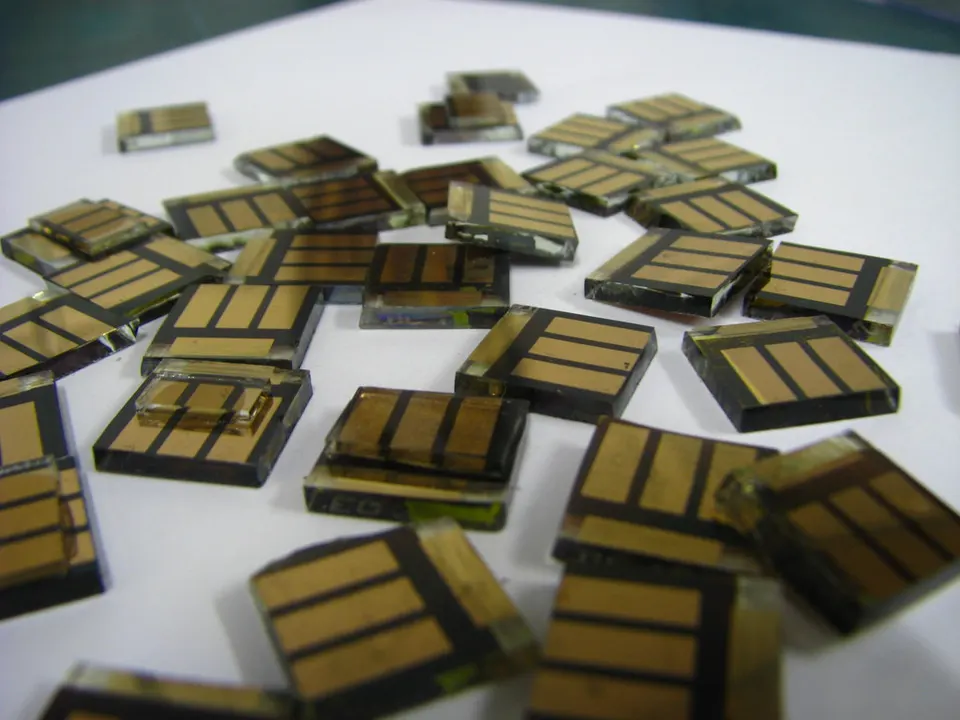
Perovskite
A crystal you can print
Perovskites are crystals, e.g. of lead, iodide and small organic ions, that absorb light strongly and can be coated as thin films at low temperature.
Tandem
Two layers split the spectrum
A top cell with a wider bandgap turns blue light into higher voltage; red light passes to a bottom cell, so less energy is lost as heat.
Pairing
Perovskite over another cell
Stacking a perovskite on silicon or CdTe can beat the ~33% single-layer limit; lab perovskite-silicon tandems have passed 33%.
Update log
May 2023
- Minor: PressResearch
About First Solar
First Solar
CdTe thin-film modules, US manufacturing
Arizona company making thin-film solar panels from cadmium telluride (CdTe), and the largest US solar maker. Its factories turn glass into a finished panel in hours. It bought perovskite developer Evolar in 2023 to work on tandem cells.
- The only top-10 panel maker not using silicon, so it avoids Chinese polysilicon supply chains.
- Opened new US factories in Alabama and Louisiana in 2024-2025, helped by IRA manufacturing credits.
- Bought Swedish perovskite developer Evolar in 2023 to pursue tandem cells.
- Founded
- 199927 yrs
- Headquarters
- United States
- Status
- Public
- Listed
- FSLR (opens google.com)NASDAQ
- Valuation
- public
- Coverage
- 2 programs · 4 updateslatest 1 Jul 2025checked 25 Sep