

Milestones
- Starcloud-1 launched with NVIDIA H1002 Nov 2025Complete.
- First LLM trained and run in orbitDec 2025Complete.
- Starcloud-2 launchNowCurrent milestone.
Most important updates
- 21 Aug 2026
- 30 Mar 2026
- 2 Nov 2025
Upcoming
- 2027Launch of two 8 kW Starcloud-2 satellites (next)
Current obstacles
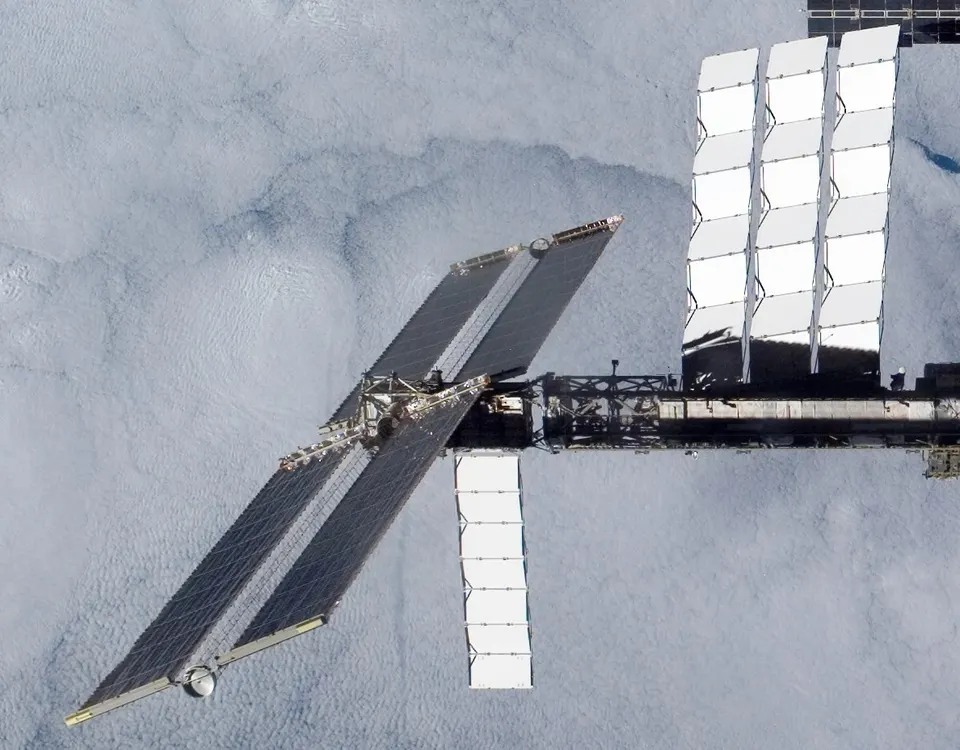
- Heat rejectionIn vacuum, heat only leaves by radiating, so powerful GPUs need large, light radiators.
- Radiation and launch costNormal GPUs must survive space radiation, and launches must get much cheaper.
Physics limits
- Heat can leave only as radiationIn vacuum there's no air to carry heat, so it leaves only as infrared. At about 20 °C a surface radiates roughly 400 W per m² per side, so megawatts of chips need thousands of m² of radiators.
- Radiation flips bits and ages chipsAbove the atmosphere, cosmic rays and trapped protons flip memory bits and slowly damage transistors. Commercial GPUs aren't built for this, and shielding adds mass that must be launched.
- Sunlight delivers only 1.36 kW per m²Panels in orbit receive about 1,361 W/m² and convert about 30% of it. A 1 MW cluster therefore needs roughly 2,500 m² of panels, plus radiators of similar size.
How it works
Power
Near-constant sunlight
In a dawn-dusk orbit the solar panels see the Sun almost all the time, so little battery storage is needed for night.
Compute
Data-center GPUs in orbit
Starcloud-1 flew an NVIDIA H100, which the company says is about 100 times more powerful than any GPU flown before.
Cooling
Radiators to space
Heat is carried to panels that radiate it into space as infrared, since there is no air or water to cool chips.
Update log
Fri 21 Aug
- Minor: PressFunding
Mon 30 Mar
- Major: PressFunding
Sun 2 Nov 2025
- Major: OtherTest
About Starcloud
Starcloud
Data centers in orbit
Starcloud (formerly Lumen Orbit) is a Redmond, Washington startup building data centers in orbit, where sunlight is almost constant. Its first satellite carried an NVIDIA H100 GPU and ran AI models in space.
- Starcloud-1 launched in Nov 2025 with an NVIDIA H100, then the most powerful GPU in space.
- Raised a $170M Series A at a $1.1B valuation led by Benchmark and EQT Ventures (March 2026).
- Starcloud-2 will carry a Blackwell GPU and a large fold-out radiator.
- Founded
- 20242 yrs
- Headquarters
- United States
- Status
- Private
- Valuation
- $1.1BprivateMar 2026
- Raised
- $420M2 rounds
- Last round
- Venture round · $250MAug 2026
- Works in
- ComputingSpace data centersSpaceflight
- Coverage
- 1 program · 3 updateslatest 21 Aug 2026checked 25 Sep
- Lead investors
- BenchmarkEQT Ventures
- Partners
- NVIDIA
- Suppliers
- SpaceX
- People
- Philip JohnstonCo-founder and CEO