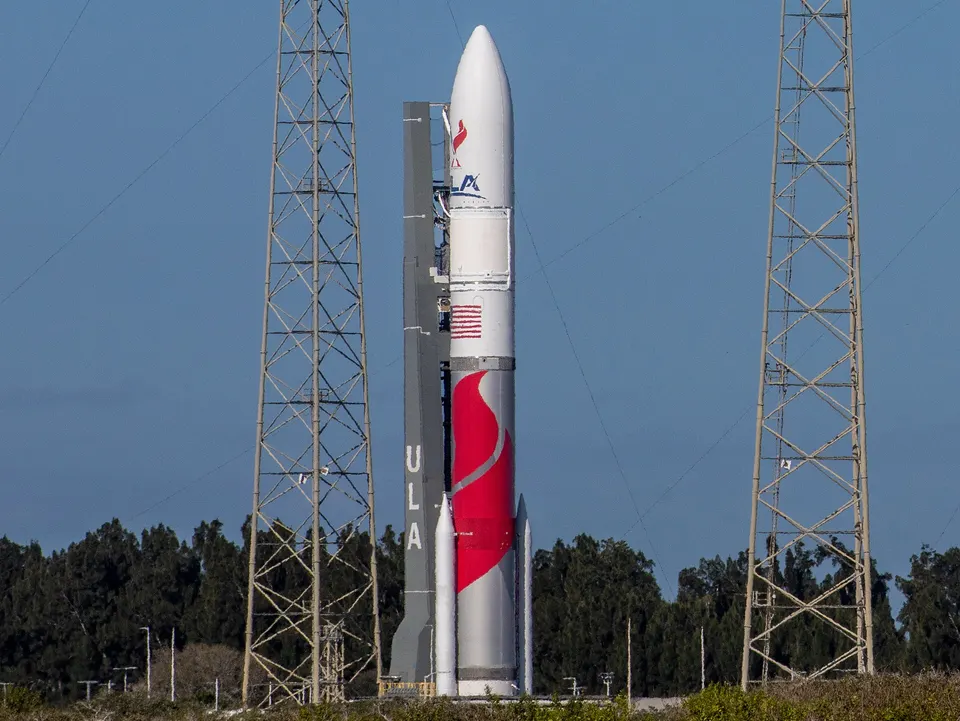

Milestones
- First launch (Peregrine lunar lander)8 Jan 2024+60 mo
originally 2019Complete. - Second flight reaches orbit despite losing a booster nozzle4 Oct 2024Complete.
- Cleared for US military launches26 Mar 2025Complete.
- First US military mission (USSF-106)12 Aug 2025Complete.
Most important updates
- 14 May 2026
- 26 Feb 2026
- 12 Feb 2026
- 26 Mar 2025
- 29 Mar 2023
Upcoming
- Q4 2026Vulcan return to flight targeted by end of 2026 (next)
Current obstacles
- Few launches, no reuseA rocket thrown away after a handful of flights a year costs more than reusable rivals; plans to recover its engines aren't ready.
Physics limits
- The rocket equation makes payload a sliver of launch massOrbit needs about 9.4 km/s of speed change including losses. Fuel needed grows exponentially with that, so even the best rockets put only 2 to 5% of their liftoff mass into low orbit.
- Solid boosters can't be shut off or throttledOnce lit, a solid motor burns until empty. Its nozzle throat faces 3,000 °C gas for the whole burn, and erosion or a flaw can't be corrected in flight.
- Throwaway rockets pay for new hardware each flightWith no stage recovered, every launch costs a full set of engines and tanks. Cost falls only through volume, never by reuse.
How it works
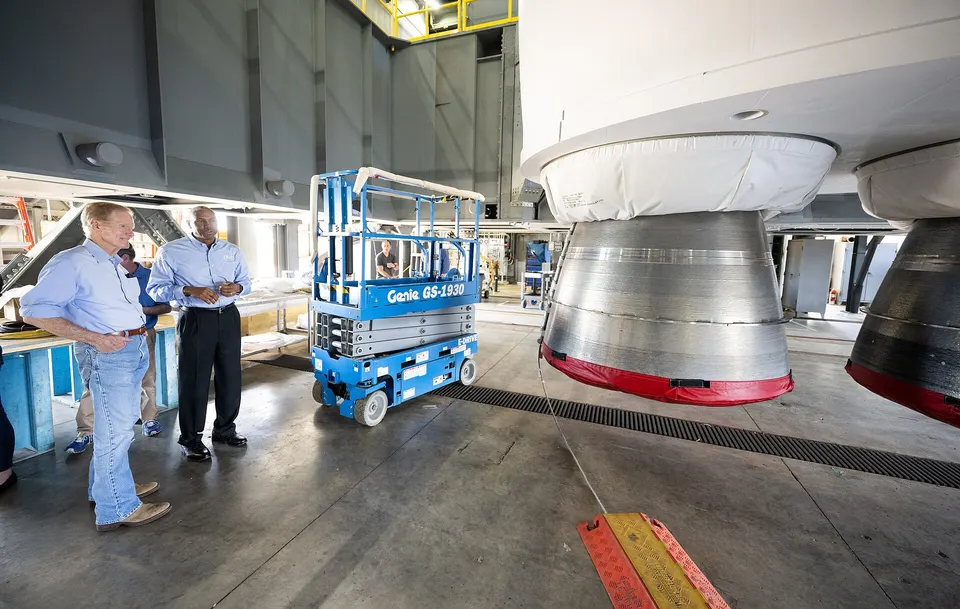
Core
Two methane engines
The core stage uses two Blue Origin BE-4 engines burning methane and liquid oxygen, the same engine as New Glenn.
Boosters
Up to six solid boosters
Strap-on GEM 63XL solid motors add thrust at liftoff; the number (0, 2, 4 or 6) is chosen to match the payload.
Centaur V
A hydrogen upper stage
Two RL10 hydrogen engines on the thin-walled Centaur V give very high efficiency for long burns to high orbits.
Update log
Thu 14 May
- Minor: PressTest
Thu 26 Feb
- Major: PressRegulatory
Thu 12 Feb
- Major: PressTest
Wed 26 Mar 2025
- Major: PressRegulatory
Wed 29 Mar 2023
- Major: PressTest
About United Launch Alliance
United Launch Alliance
Vulcan rocket, US military launches
A Boeing and Lockheed Martin joint company that launches US military, NASA and commercial satellites. Its Vulcan rocket, using Blue Origin engines, entered service in 2024 and was cleared for military missions in 2025.
- Vulcan was cleared for US military launches in March 2025, despite losing a booster nozzle on its second flight.
- CEO Tory Bruno left for Blue Origin at the turn of 2026; Mark Peller was named CEO in August 2026.
- Over 80 missions booked, including Amazon's internet satellites.
- Founded
- 200620 yrs
- Headquarters
- United States
- Status
- Subsidiaryof Boeing / Lockheed Martin JV
- Valuation
- Boeing / Lockheed Martin JV-owned
- Works in
- SpaceflightLaunch
- Coverage
- 1 program · 7 updateslatest 17 Aug 2026checked 25 Sep
- Suppliers
- Blue Origin
- People
- Mark Peller (opens ulalaunch.com)CEO