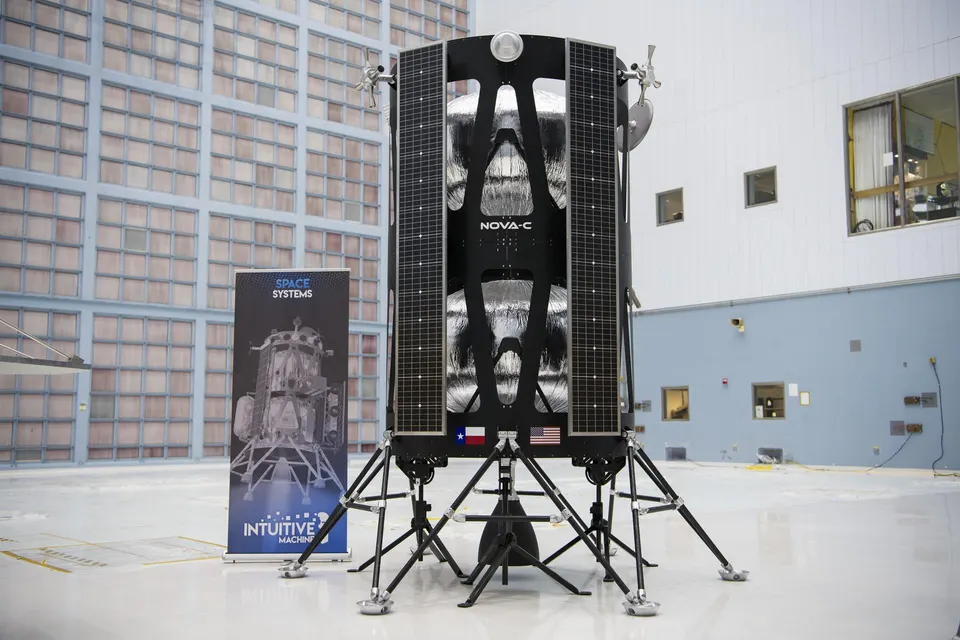

Milestones
- IM-1 Odysseus lands near Malapert A, tips over22 Feb 2024Complete.
- IM-2 Athena lands near the south pole on its side6 Mar 2025Complete.
- IM-3 to Reiner GammaNot yet reached.
Most important updates
- 30 Jun 2026
- 6 Mar 2025
- 27 Feb 2025
- Sep 2024
- 22 Feb 2024
Current obstacles
- Staying uprightBoth landers ended on their side, pointing to sensor problems and landing too fast on a tall, narrow design.
Physics limits
- Tall landers topple on uneven groundA tall, narrow lander that is still drifting sideways or lands on a slope can tip. Both Nova-C landings ended on their sides; lowering the centre of gravity costs payload room.
- Solar landers die in the lunar nightA lunar night lasts about 14 Earth days at about −170 °C. Without nuclear heat, batteries can't keep electronics alive that long, so missions end with sunset.
- No air: landing is all rocket brakingCancelling about 1.7 km/s of orbital speed uses engines alone. Every kilogram of payload needs extra fuel, and there is no second attempt.
How it works
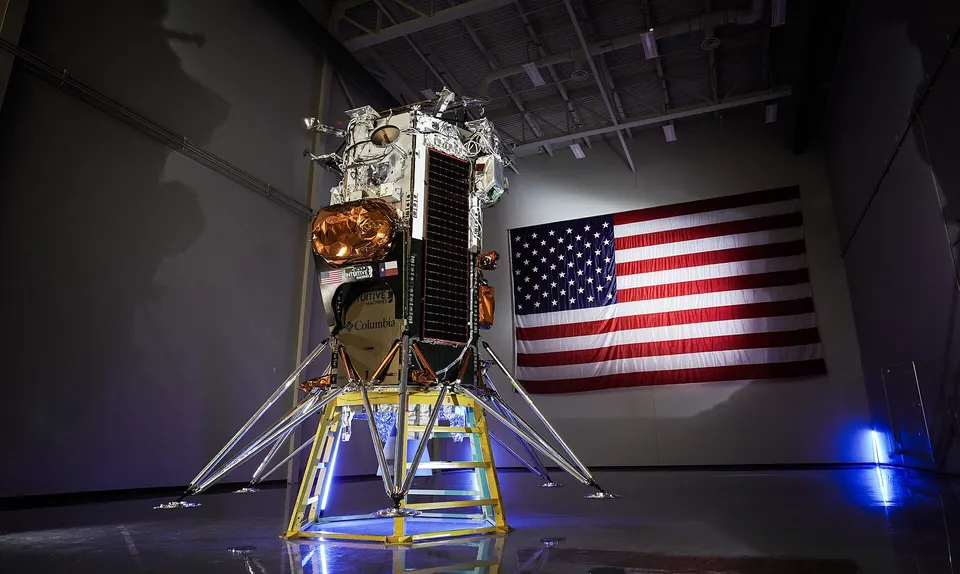
Engine
Super-cold methane and oxygen
Its main engine burns liquid methane and oxygen, stored cold, to brake from lunar orbit and hover to a landing.
Navigation
Finding the ground by itself
Cameras and laser rangefinders measure height and drift, since signals from Earth are too slow to fly it by hand.
Legs
Six legs, tall body
A 4 m tall hexagonal body on six legs carries payloads to the surface; it runs on solar power for about one lunar day.
Update log
Tue 30 Jun
- Minor: PressCommercial
Thu 6 Mar 2025
- Major: PressTest
Thu 27 Feb 2025
- Minor: OtherTest
Sep 2024
- Major: PressCommercial
Thu 22 Feb 2024
- Major: PressTest
Thu 15 Feb 2024
- Minor: OtherTest
About Intuitive Machines
Intuitive Machines
Nova-C Moon landers, Moon comms
Intuitive Machines builds Nova-C Moon landers and Moon communications for NASA. In Jan 2026 it bought satellite maker Lanteris (formerly Maxar Space Systems) for $800M. Its IM-1 was the first US Moon landing since 1972.
- IM-1 (Feb 2024) and IM-2 (Mar 2025) both landed but tipped onto their sides.
- Has a NASA contract to relay data from the Moon.
- Buying Lanteris makes it a bigger spacecraft builder.
intuitivemachines.com (opens intuitivemachines.com)Company profile →
- Founded
- 201313 yrs
- Headquarters
- United States
- Status
- Public
- Listed
- LUNR (opens google.com)NASDAQ
- Valuation
- public
- Works in
- SpaceflightMoon & deep space
- Coverage
- 1 program · 7 updateslatest 30 Jun 2026checked 25 Sep
- Customers
- NASA (opens nasa.gov)
- People
- Steve AltemusCo-founder and CEO