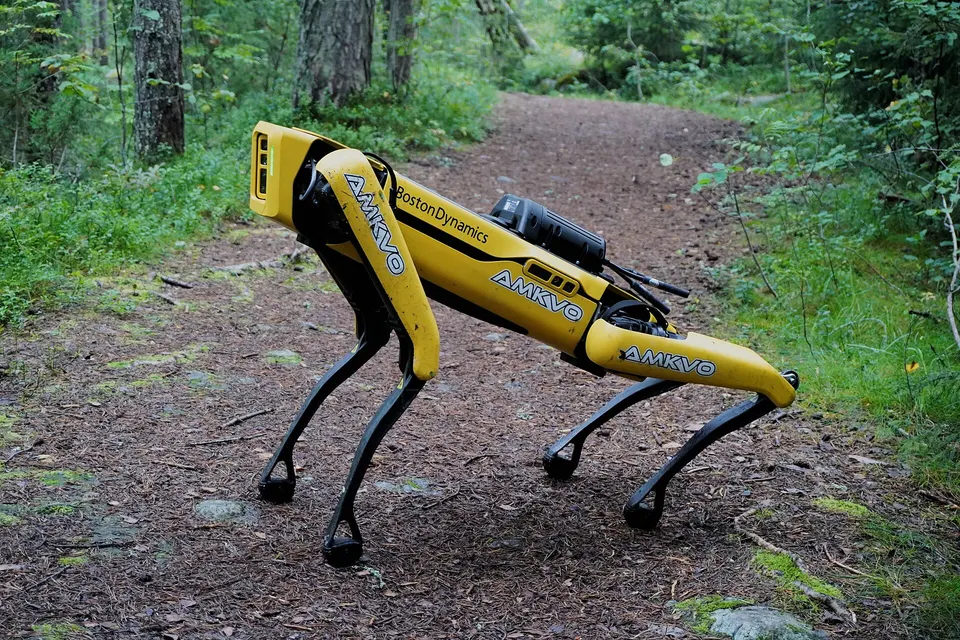

Milestones
- Early-adopter programmeSep 2019Complete.
- General commercial salesJun 2020Complete.
- Spot Arm and self-charging dockFeb 2021Complete.
Most important updates
- Jul 2026
- 14 Apr 2026
- 12 Mar 2026
- 2 Feb 2021
- 16 Jun 2020
Current obstacles
- Price versus inspection valueSpot competes with fixed sensors and cheaper robot dogs. Proving it pays off at each site keeps fleets small.
Physics limits
- Legs spend energy that wheels don'tEvery step speeds up and stops the leg's mass and lifts the body a little. Walking therefore costs several times more energy per metre than rolling, which keeps runtime to about 90 minutes per battery.
- Grip on the ground is capped by frictionA foot can push sideways only up to friction times its load. On ice the friction coefficient is about 0.1, so the robot can barely turn or brake, however smart its controller.
- Steel plants block radioMetal walls and pipes reflect and absorb radio waves, so links to an operator drop inside plants and tunnels. The robot must act alone or rely on repeaters.
How it works
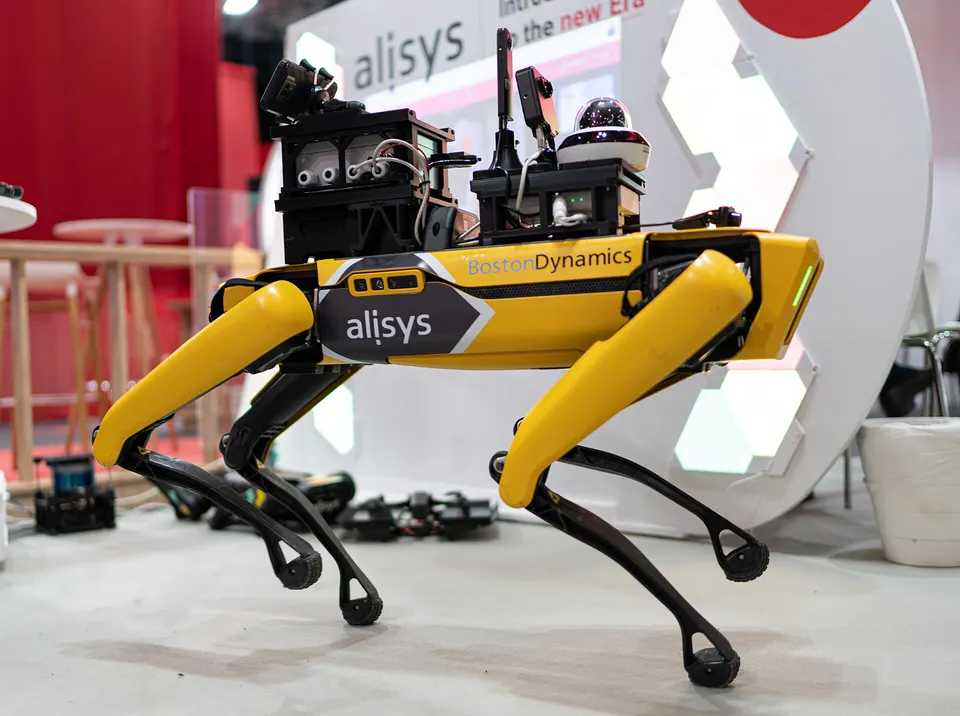
Three motors per leg
Each leg has two hip joints and a knee, 12 motors in all. Software adjusts every step many times a second to stay balanced on stairs, gravel and slopes.
Stereo cameras all round
Five pairs of stereo cameras build a 3D picture of the ground, so Spot places its feet and steps around obstacles without a prebuilt map.
Walk a route once, repeat it
An operator drives a route once; Spot then repeats it alone, docks to charge and sends gauge readings, thermal images and sounds to Orbit software.
Optional arm on its back
A jointed arm with a camera in its gripper lets Spot open doors, turn valves and pick things up.
Update log
Jul 2026
- Minor: BlogTest
Tue 14 Apr
- Minor: PressSoftware
Thu 12 Mar
- Minor: PressPartnership
Tue 2 Feb 2021
- Major: PressHardware
Tue 16 Jun 2020
- Major: PressCommercial
About Boston Dynamics
Boston Dynamics
Atlas humanoid, Spot robot dog, Stretch
Boston Dynamics, founded in 1992 by Marc Raibert, pioneered robots that walk and balance. Owned by Hyundai since 2021, it sells Spot and Stretch and began building its electric Atlas humanoid in 2026.
- Production Atlas (CES, Jan 2026): fully electric, 56 degrees of freedom, lifts 50 kg, swaps its own batteries.
- Hyundai is the main customer and plans a factory able to build 30,000 robots a year.
- Spot and Stretch bring real revenue and field data that most humanoid startups lack.
bostondynamics.com (opens bostondynamics.com)Company profile →
- Founded
- 199234 yrs
- Headquarters
- United States
- Status
- Subsidiaryof Hyundai Motor Group
- Valuation
- $21BHyundai Motor Group-ownedMar 2026estimate
- Works in
- RoboticsHumanoids
- Coverage
- 3 programs · 18 updateslatest 18d agochecked 25 Sep
- People
- Marc Raibert (opens en.wikipedia.org)FounderRobert PlayterCEO