
Milestones
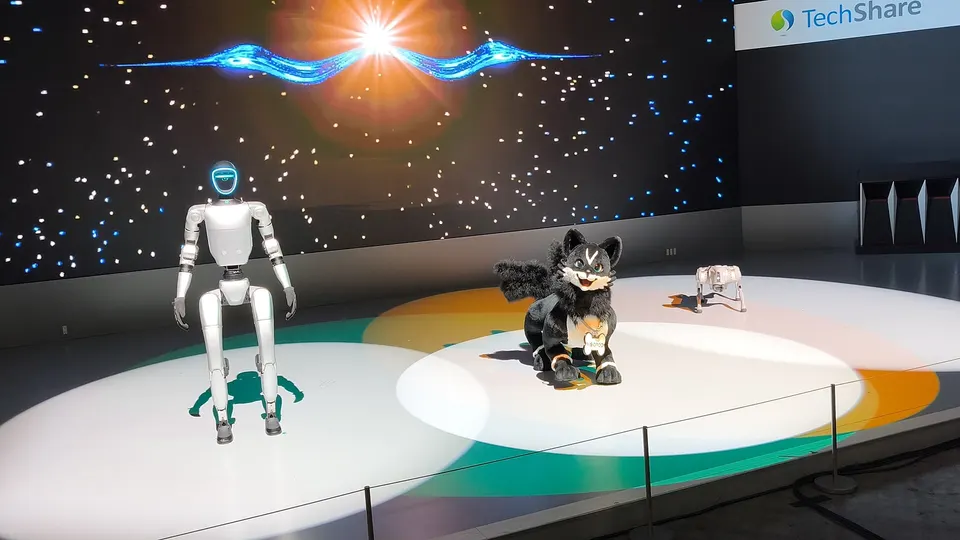
- H1 full-size humanoid launchedAug 2023Complete.
- G1 launched at ~99,000 yuanMay 2024Complete.
- R1 launched at 39,900 yuanJul 2025Complete.
- H2 full-size humanoid unveiledOct 2025Complete.
Most important updates
- 26d ago
- Aug 2026
- 28 Jul 2026
- Sep 2025
- 13 May 2024
Current obstacles
- Hands and payloadSmall size and low cost limit how much it can lift and how skilled its hands are.
Physics limits
- Small motors overheat under loadCompact joint motors can deliver peak torque for flips only briefly: heating rises with the square of current. Sustained lifting or carrying quickly hits the thermal limit.
- Short runtimeA 35 kg robot can carry only a small battery. At lithium-ion's ~250 Wh per kg, the G1 runs about two hours per charge, and more battery means more weight to move.
- Hands without a sense of touchHuman fingertips resolve details about 2 mm apart and sense slip within milliseconds. Low-cost robot hands have few or no touch sensors, so fine handling relies on cameras alone.
How it works
23 to 43 in-house motors
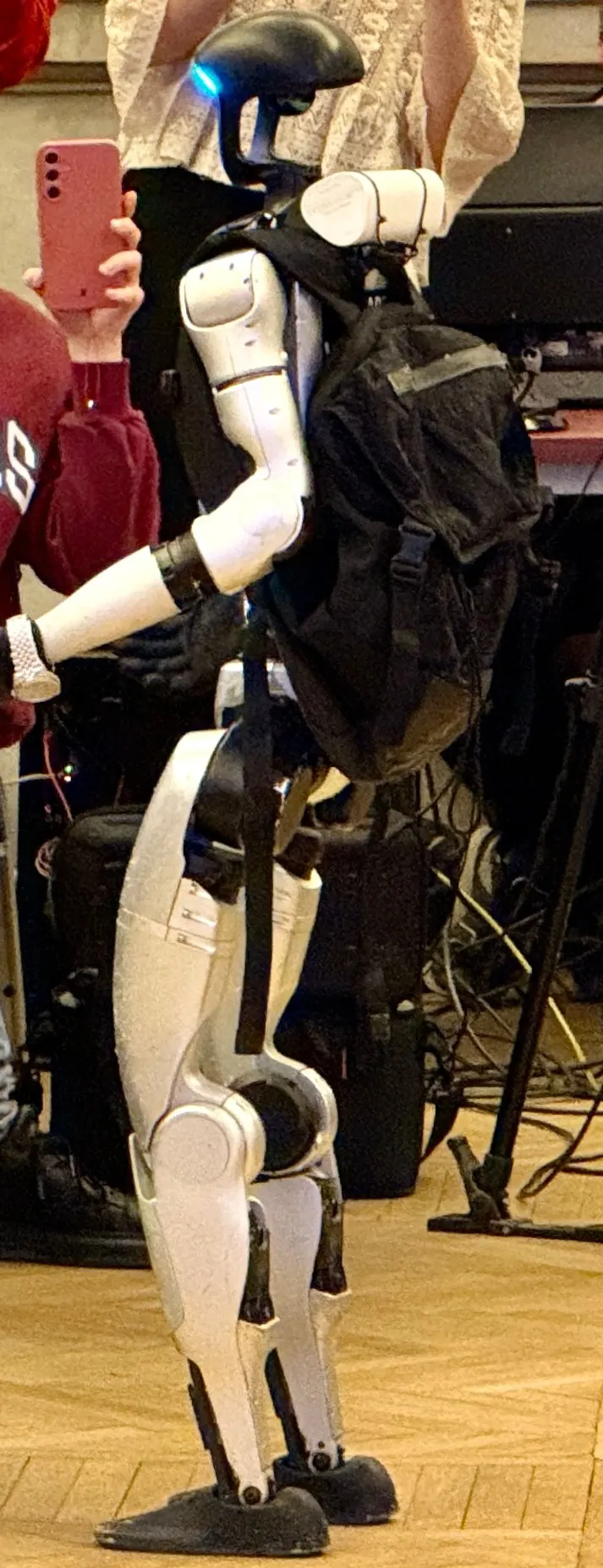
Base G1s have 23 joint motors; research versions add wrists and dexterous hands for up to 43. Unitree makes its own motors to keep the price low.
Depth camera and 3D lidar
A depth camera and a 3D lidar in the head map the surroundings, so the robot can walk over uneven ground.
Moves learned in simulation
Walking, running and flips are trained with reinforcement learning in simulation, then transferred to the real robot.
Built for developers
An SDK and ROS support let labs run their own control code on it, which is why it became a common research platform.
Spec sheet
| Spec | G1 |
|---|---|
| Height | ~1.3 mR (reported) |
| Weight | ~35 kgR (reported) |
| Base price | ~99,000 yuan (~$16k)R (reported) |
R reported by the company
Peer comparison
| Spec | G1 | Boston Dynamics Atlas |
|---|---|---|
| Height | ~1.3 mR (reported) | 1.9 mR (reported) |
| Weight | ~35 kgR (reported) | 90 kgR (reported) |
R reported by the company
Update log
Mon 14 Sep
- Minor: PressHardware
Aug 2026
- Minor: PressOther
Tue 28 Jul
- Major: PressRegulatory
Mon 16 Feb
- Minor: PressOther
Sep 2025
- Major: PressOther
Sun 25 May 2025
- Minor: PressOther
Mon 13 May 2024
- Major: PressHardware
About Unitree Robotics
Unitree Robotics
Low-cost humanoids and robot dogs
Unitree Robotics makes low-cost robot dogs and humanoids (Go2, G1, H2), sold widely to labs, schools and developers. Founded in 2016 by Wang Xingxing, it listed in Shanghai in August 2026, the first humanoid maker listed in mainland China.
- Price leader: the G1 humanoid launched in 2024 at about 99,000 yuan (~$16k), the R1 in 2025 at 39,900 yuan.
- Revenue grew from 159M yuan (2023) to about 1.7B yuan (2025), per its IPO filings.
- Shares rose 460% on their August 2026 debut, closing at a value of about 342B yuan.
- Founded
- 201610 yrs
- Headquarters
- China
- Status
- Public
- Listed
- 688836 (opens google.com)SSE STAR
- Valuation
- $47Best. market capAug 2026estimate
- Works in
- RoboticsHumanoids
- Coverage
- 1 program · 9 updateslatest 26d agochecked 25 Sep
- Investors
- Tencent (opens tencent.com)
- People
- Wang Xingxing (opens en.wikipedia.org)Founder & CEO