
Milestones
- Phoenix 100-qubit prototype2021Complete.
- 1,180-qubit array24 Oct 2023Complete.
- 24 entangled logical qubits with Microsoft19 Nov 2024Complete.
- Magne system announced in DenmarkJul 2025Complete.
- Magne operationalTarget 2027Not yet reached.
Most important updates
- 16 Jun 2026
- 3 Jun 2026
- 7 Nov 2025
- 19 Nov 2024
- 24 Oct 2023
Upcoming
- 2027Magne operational (next)
Current obstacles
- Atom loss and reloadingAtoms slowly escape their traps. Long programs need them reloaded without disturbing the other qubits.
Physics limits
- Atoms get lostAtoms sit in vacuum held only by light. Collisions with leftover gas and imperfect imaging knock some out every cycle, so large arrays must be refilled while computing.
- Rydberg states decayEntangling gates briefly use Rydberg states that decay within about a hundred microseconds, and laser noise adds errors. Together these cap two-qubit fidelity at around 99.5% today.
- Reading atoms is slowImaging atoms to read them takes milliseconds, thousands of times slower than superconducting readout, so each round of error correction takes much longer.
How it works
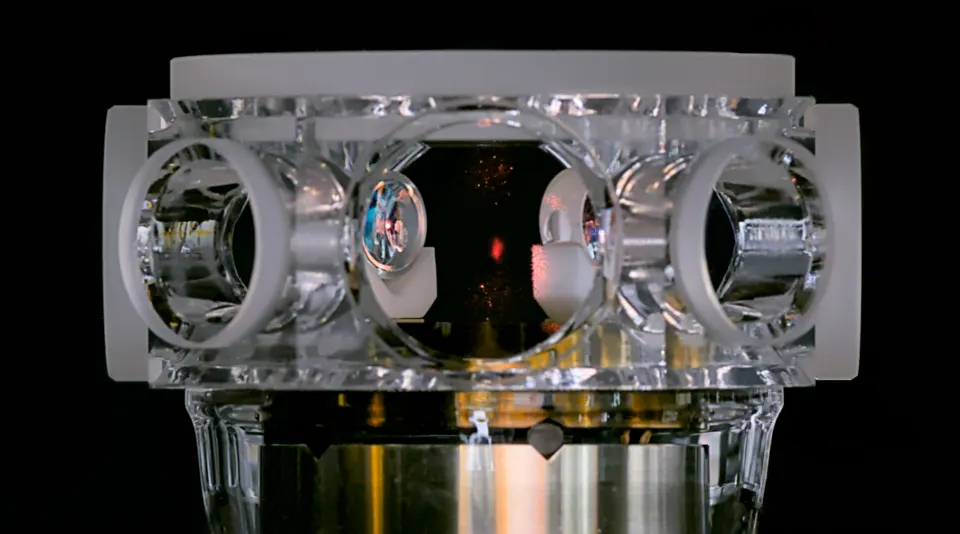
Ytterbium atoms in laser tweezers
Neutral ytterbium-171 atoms are held by focused laser beams. Their nuclear spin stores the qubit and is very well shielded from noise.
Rydberg interactions
Lasers briefly push pairs of atoms into giant 'Rydberg' states that interact strongly, which entangles them.
Reloading and reuse
Lost atoms are replaced from a reservoir mid-program, and qubits can be measured mid-circuit and reused.
Microsoft's error-correction stack
Microsoft's software encodes logical qubits across many atoms and decodes errors as the program runs.
Update log
Tue 16 Jun
- Major: PressFunding
Wed 3 Jun
- Major: PressResearch
Fri 7 Nov 2025
- Minor: PressOther
Tue 19 Nov 2024
- Major: BlogResearch
Tue 24 Oct 2023
- Major: PressHardware
Wed 31 May 2023
- Minor: BlogResearch
About Atom Computing
Atom Computing
Neutral-atom computers, ytterbium qubits
Atom Computing builds neutral-atom quantum computers. Qubits live in the nuclear spin of ytterbium atoms held by laser tweezers, which keeps them stable for a long time. It was first past 1,000 atom sites and works with Microsoft.
- Announced a 1,225-site atom array with 1,180 qubits in October 2023.
- With Microsoft, entangled 24 logical qubits in November 2024.
- Building Magne, a machine with about 50 logical qubits, in Denmark.
atom-computing.com (opens atom-computing.com)Company profile →