

Milestones
- Passage announced2023Complete.
- Passage M1000 reference platform31 Mar 2025Complete.
- Passage L200 co-packaged opticsApr 2025Complete.
- Volume customer deploymentsNowCurrent milestone.
Most important updates
- 2 Jun 2026
- 11 Mar 2026
- 26 Jan 2026
- 18 Aug 2025
- Oct 2024
Current obstacles
- Laser reliability and packagingOptics next to hot GPUs must survive heat. Laser lifetime and attaching fibres reliably are hard.
Physics limits
- Silicon can't make its own lightSilicon has an indirect bandgap, so it can't emit light efficiently. Lasers must be made from other materials such as indium phosphide, which cost more and wear out sooner than silicon chips.
- Light can't be squeezed like electronsDiffraction keeps optical waveguides around half a micrometre wide at telecom wavelengths, hundreds of times wider than the finest wires, so photonic circuits can't be packed as densely as electronics.
- Converting to light and back costs energyEach electrical-to-optical conversion and back costs picojoules per bit. Over the few millimetres inside a package, plain copper can still be cheaper, so optics win only beyond a certain distance.
How it works
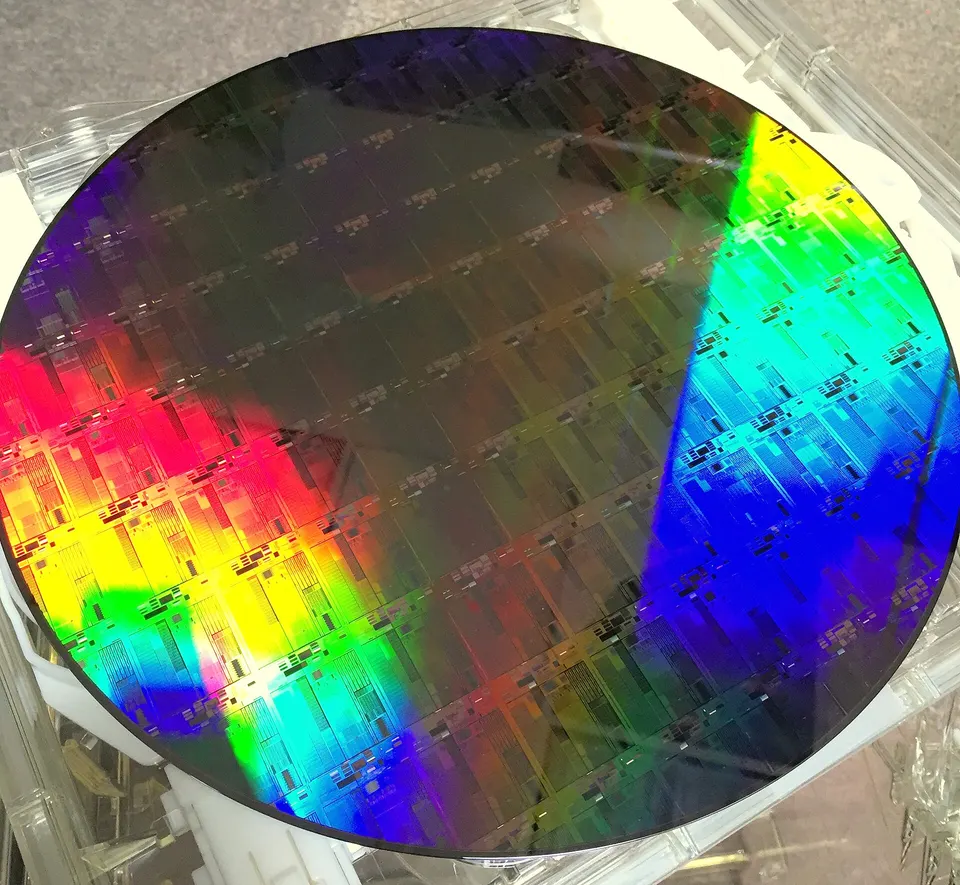
Light replaces copper
Modulators on a silicon photonics chip turn electrical signals into light, which travels through waveguides and fibre with little loss over distance.
A photonic base under the chips
In M1000, GPUs or switches sit on a large photonic interposer that routes light between them and out to 256 fibres, about 114 Tbps in total.
Optics inside the package
L200 is a 3D-stacked optical chiplet in the same package as the processor, giving 32–64 Tbps without transceivers at the board edge.
Many wavelengths per fibre
Several colours of light share each fibre (16 in Lightmatter's 2025 demo), multiplying bandwidth without adding fibres.
Update log
Tue 2 Jun
- Minor: PressPartnership
Wed 11 Mar
- Minor: PressHardware
Mon 26 Jan
- Minor: PressPartnership
Mon 18 Aug 2025
- Minor: PressResearch
Thu 14 Nov 2024
- Minor: PressPartnership
Oct 2024
- Major: PressFunding
About Lightmatter
Lightmatter
Optical chip links, Passage
Lightmatter uses light to move data between chips. Its Passage products aim to remove bandwidth limits in large GPU clusters. It also showed a chip that runs neural networks with light.
- Raised $400M Series D at a $4.4B valuation led by T. Rowe Price (Oct 2024).
- Passage M1000 (2025) is an optical base for chips with 114 Tbps of total bandwidth.
- Published a light-based processor running AI models in Nature (April 2025).
- Founded
- 20179 yrs
- Headquarters
- United States
- Status
- Private
- Valuation
- $4.4BprivateOct 2024
- Raised
- $400M1 round
- Last round
- Series D · $400MOct 2024$4.4B post
- Works in
- ComputingPhotonics & interconnect
- Coverage
- 1 program · 7 updateslatest 2 Jun 2026checked 25 Sep
- Lead investors
- T. Rowe Price
- People
- Nick HarrisCo-founder and CEO