
The brief
- No dies needed: those take months and millions to make, so a new part can go from design file to metal in days.
- The US Air Force has ordered its RoboCraftsman robot cells to make aircraft repair parts.
- Its $124M raise (Feb 2026) funds a 200,000 sq ft factory for up to 50 robot cells.
Technical approach
Forming
Two arms, one sheet
Two robot arms press a metal sheet from both sides with small tools, stretching it into shape bit by bit.
Sensing
Scan and correct
Parts are laser-scanned; software fixes the robot paths so the metal springs back less and each part gets more accurate.
Cell
Several jobs in one cell
The same cell switches tools to trim, drill and inspect, so fewer handoffs are needed.
Data
Learning from every part
Force and scan data from each part trains better models, its long-term edge over stamping.
Programs
Machina Labs, one program
Updated 4 Feb 2026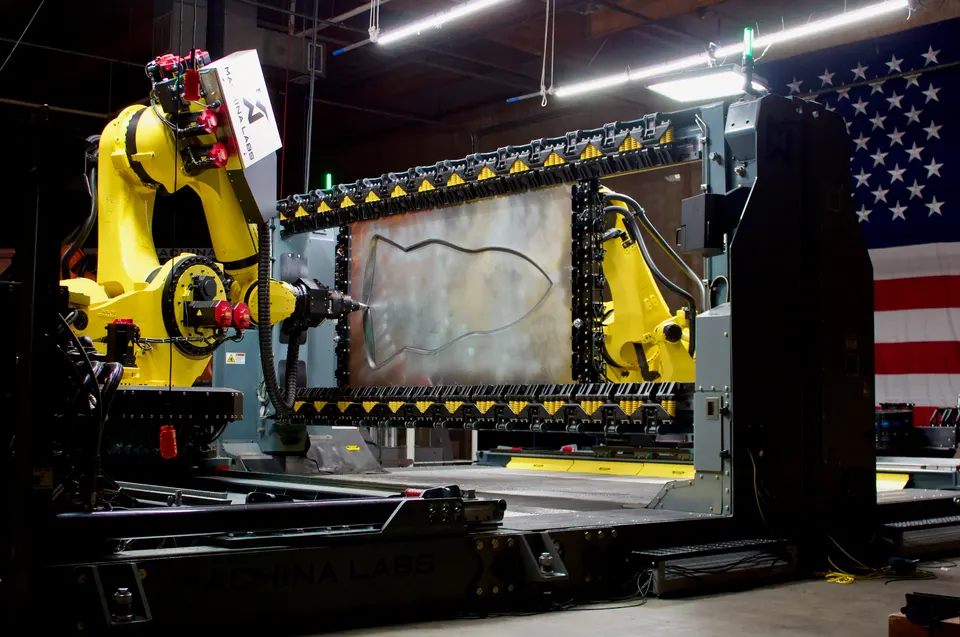
Research · Proto · Pilot · Deploy · Scaling
Open technical problems
- SpeedActive research
Each part takes minutes to hours versus seconds for stamping, so it wins on small batches, not mass production.
- Proving the metal is soundPartially solved
Shaping changes the metal's thickness and grain; aircraft makers need proof it is consistent before approving parts.
Peers
Company & funding
- Raised
- $156Mdisclosed private rounds
- Last round
- Series C4 Feb 2026
- HQ
- US
- Founded
- 2019
| Date | Round | Amount | Post-money | Lead |
|---|---|---|---|---|
| 4 Feb 2026 | Series C | $124M | — | — |
| Aug 2022 | Series A | $32M | — | Innovation Endeavors |
Partners & customers
- Customer
RoboCraftsman orders and an AFRL contract for aircraft repair parts.
- Investor
- InvestorWoven Capital
Toyota's growth fund; Series C investor.
People
- Edward MehrCo-founder & CEO
- Babak RaeisiniaCo-founder