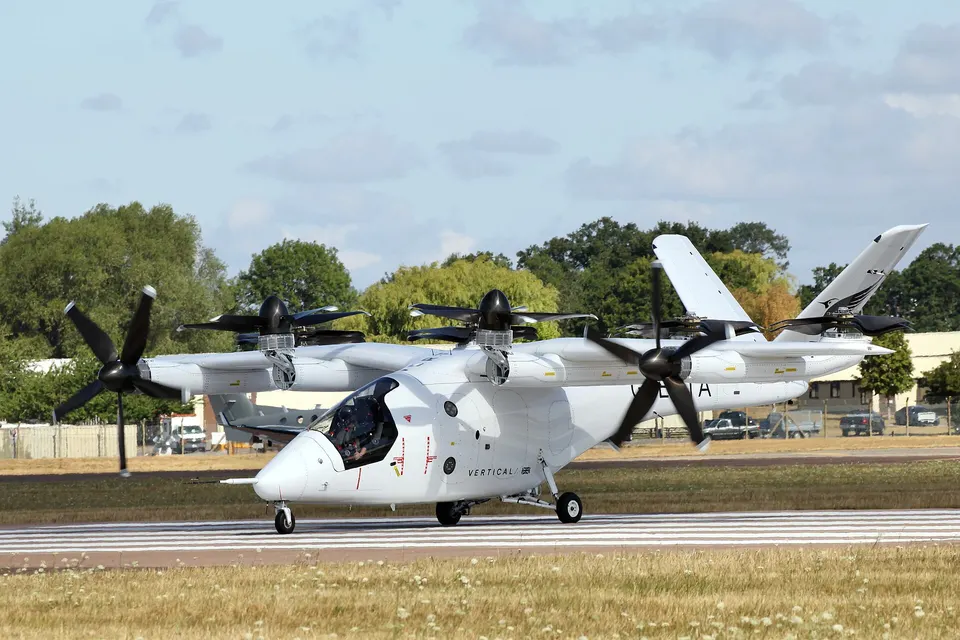

Milestones
- Piloted hover-to-wing tests begin13 Nov 2025Complete.
- First piloted switch to wing-borne flight2 Apr 2026+4 mo
originally Dec 2025Complete. - UK type certificate (safety approval)Not yet reached.
Most important updates
- 21 Jul 2026
- 2 Apr 2026
- 13 Nov 2025
- 28 Jan 2025
- 9 Aug 2023
Current obstacles
- Running out of moneyApproval needs hundreds of millions more; Vertical depends on investors continuing to pay.
Physics limits
- Batteries hold about 40 times less energy per kilo than jet fuelThe best lithium-ion cells store roughly 0.25–0.3 kWh per kg; kerosene holds about 12 kWh per kg. Even after motors' higher efficiency, that caps range at tens of miles, and a battery weighs the same when empty.
- Hovering on small rotors costs several times the power of cruiseA rotor lifts by pushing air down; the power needed rises as disc area shrinks. Small propellers must move air fast, so take-off and landing burn a big share of each trip's energy and stress the battery hardest.
- Noise climbs steeply with blade-tip speedRotor noise grows very quickly as blade tips speed up. Making an air taxi quiet means bigger, slower-turning rotors, which add weight and drag; every design trades quietness against payload and range.
How it works
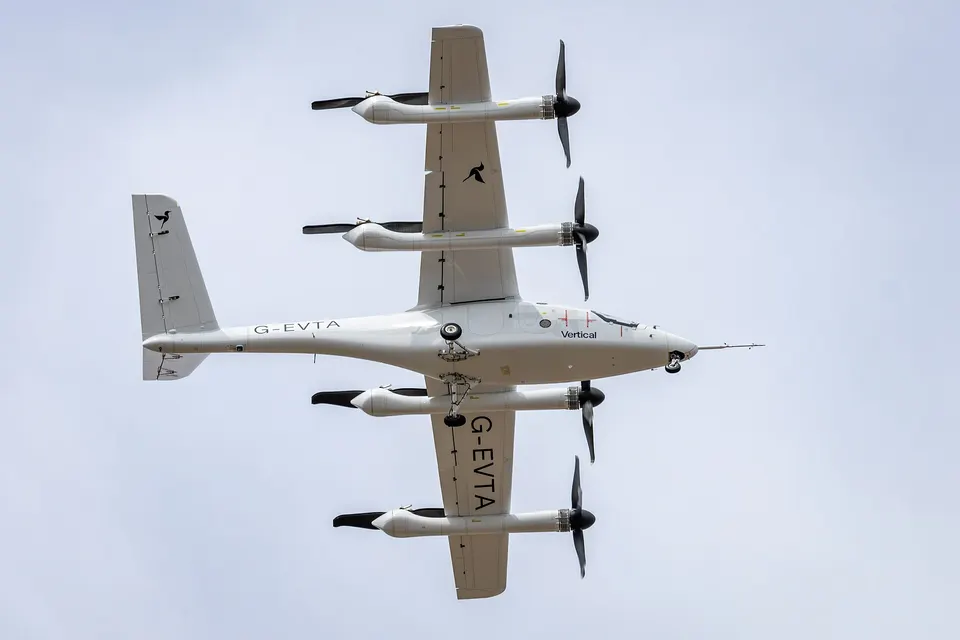
Lift
Eight propellers lift it up
Four tilting front propellers and four fixed rear ones lift it straight up from a pad, like a large drone.
Transition
Front propellers tilt forward
As speed builds the front four swing forward and the wing takes the weight; the rear four stop and line up with the airflow.
Cruise
Wing-borne and quieter
In cruise it flies like a small plane with a pilot and four passengers, using far less power than in hover.
Update log
Tue 21 Jul
- Minor: PressTest
Thu 2 Apr
- Major: PressTest
Thu 13 Nov 2025
- Minor: PressTest
Tue 28 Jan 2025
- Minor: PressTest
Fri 19 Jul 2024
- Minor: PressHardware
Wed 9 Aug 2023
- Major: PressTest
About Vertical Aerospace
Vertical Aerospace
VX4 air taxi, UK
UK-based Vertical Aerospace is building the VX4, a four-passenger electric air taxi with eight propellers, four of which tilt. In 2026 it flew with a pilot from hover to wing-borne flight for the first time.
- Began piloted tests of the hover-to-wing switch in Nov 2025 under a UK permit.
- Flew a full piloted switch from hover to wing-borne flight in April 2026.
- Funded mostly by Mudrick Capital, after early backing from founder Stephen Fitzpatrick.
vertical-aerospace.com (opens vertical-aerospace.com)Company profile →
- Founded
- 201610 yrs
- Headquarters
- United Kingdom
- Status
- Public
- Listed
- EVTL (opens google.com)NYSE
- Valuation
- public
- Works in
- AviationAir taxis
- Coverage
- 1 program · 6 updateslatest 21 Jul 2026checked 25 Sep
- People
- Stephen Fitzpatrick (opens en.wikipedia.org)Founder